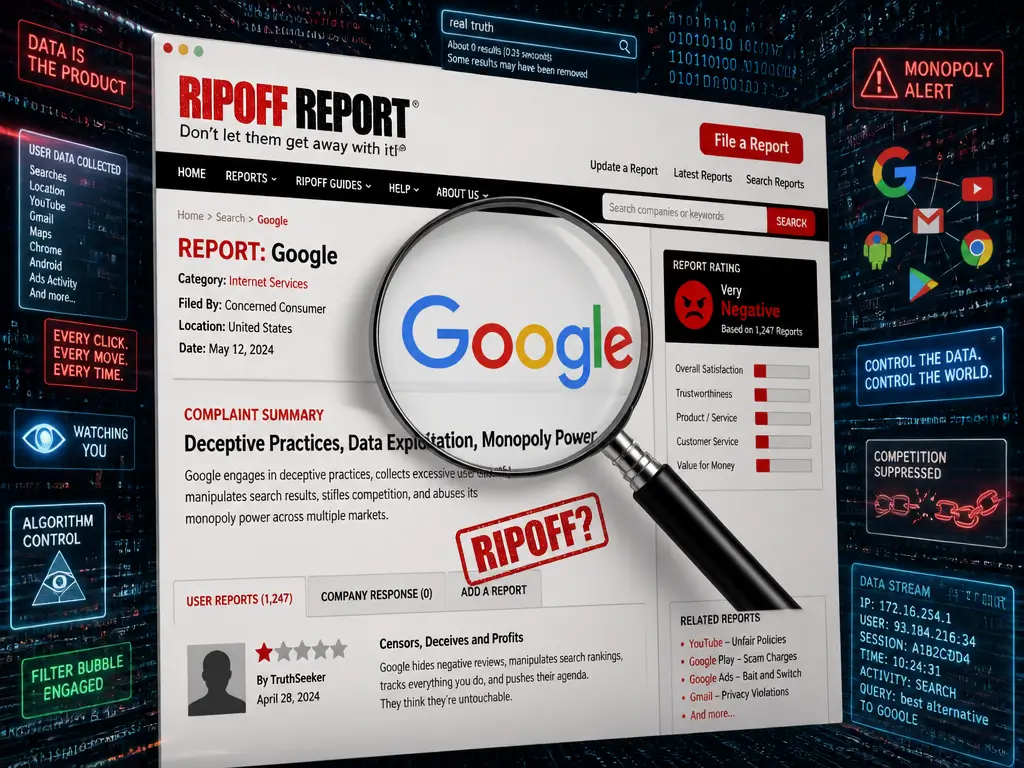
Few things rattle a business owner or professional like typing their own name into Google and finding a Ripoff Report at the top of the results. The headline is designed to alarm, the page ranks stubbornly well, and the platform has a reputation for being nearly impossible to deal with. If that’s where you are right now, take a breath — you have more options than the panic-driven advice online suggests, but you also need an honest picture of what is and isn’t realistic.
This guide walks through how Ripoff Report actually works, whether a report can be removed, and the practical paths to getting it out of your search results.
What Ripoff Report is — and why it ranks so well
Ripoff Report is a consumer complaint website where anyone can post a “report” about a business or individual, largely anonymously and without verification. The site has been online for decades, which means it carries significant domain authority in Google’s eyes. A single complaint about your business can inherit that authority and outrank your own website, your social profiles, and legitimate press coverage.
Two structural facts make Ripoff Report especially frustrating:
- It rarely comes down on its own. Reports are indexed quickly and tend to stay indexed for years.
- The platform is legally insulated. Under Section 230 of the Communications Decency Act, interactive websites in the U.S. are generally not held liable for content posted by their users. That protection is a large part of why complaint sites can decline removal requests with little consequence.
Can a Ripoff Report actually be removed? The honest answer
Here is the reality most “removal” pitches won’t tell you: Ripoff Report’s stated policy is that it does not delete reports — not at the request of the person who posted them, and not at the request of the business named in them. Anyone promising you a guaranteed deletion of the report itself is either misinformed or selling you something that doesn’t exist.
That doesn’t mean you’re stuck. It means the goal shifts from “delete the page” to “make sure almost no one ever sees it.” There are a handful of legitimate routes, and the right one depends on whether the report is defamatory, whether it violates a platform policy, and how visible it currently is.
Route 1: The platform’s own arbitration program
Ripoff Report operates a paid arbitration program intended to review specific statements within a report. An independent arbitrator examines the challenged statements and can order the redaction of anything determined to be a false statement of fact — as opposed to opinion, which is protected. The report itself typically remains live, but provably false factual claims within it can be struck through. This is narrow and evidence-driven, not a delete button, but for reports built on specific false claims it can meaningfully reduce the damage.
Route 2: Legal removal for defamation
If a report contains false statements of fact that have harmed you or your business, it may be defamatory. A successful defamation claim can produce a court order identifying the specific content as unlawful. Google reviews valid court orders through its legal removal process and, in appropriate cases, de-indexes the offending URL from search results. This route requires real evidence and usually an attorney, and outcomes depend heavily on the facts — but a court order is one of the few things that reliably moves the needle. Anonymous authorship complicates matters, though authors can sometimes be identified through legal process.
Route 3: Policy-based removal through Google
Separate from the platform, Google removes certain categories of content from search results on request — for example, pages exposing sensitive personal information such as financial account numbers or other doxxing-style data. If a Ripoff Report page contains that kind of material, Google’s own removal request tools may apply even when the report as a whole stays online.
Suppression: the realistic path for most reports
For the majority of Ripoff Report situations — where the content is negative opinion rather than provably false fact, and no court order is available — suppression is the practical solution. The principle is simple: a page that sits on page three of Google does almost none of the damage a page on page one does. Search behavior studies consistently show the overwhelming majority of clicks go to the first page, and a large share to just the top few results.
Suppression works by strengthening the pages you want people to find so they outrank the report over time. That typically includes:
- Building and optimizing owned assets — your website, an author or company bio, a strong Google Business Profile.
- Earning legitimate press, interviews, and profiles on high-authority domains.
- Developing active, well-optimized profiles on platforms Google trusts (LinkedIn, industry directories, review platforms you control).
- Publishing genuinely useful content under your name or brand that answers what people are actually searching for.
Suppression is not instant and it is not a trick — it is disciplined reputation building that gradually pushes the report down until it’s effectively invisible. This is how suppression works: done properly, it’s also the most durable outcome, because it strengthens your entire search presence rather than just fighting one page.
What to avoid
- Don’t respond publicly in anger. Rebutting on the report itself often adds keywords and freshness that help it rank higher.
- Don’t pay anyone promising a guaranteed deletion of the report. Given the platform’s policy, that promise can’t be reliably kept.
- Don’t ignore it and hope. These pages rarely fade on their own, and the longer they rank, the more authority they accumulate.
When to bring in a professional
A single dormant report with little visibility may be something you can manage yourself with patience. But if the report is ranking on the first page for your name or brand, if it’s costing you clients, or if it contains claims you believe are defamatory, professional help is usually worth it — both to pursue the narrow removal routes correctly and to run a suppression campaign that actually holds.
At MGMT Reputation, we assess each situation honestly: whether there’s a viable removal or redaction path, and where suppression is the realistic route. We don’t promise takedowns we can’t control, and we build reputation assets designed to keep the report buried for the long term. Where a formal removal attempt is also possible, that’s part of our content removal services. If the report is part of a wider pattern of negative content, our harmful online content removal and negative article removal approaches address the full picture.
Want a straight assessment of your Ripoff Report situation? Get in touch for a confidential review, and we’ll tell you what’s realistically achievable — no inflated promises.