

Google reviews carry real weight. A three-star rating pulls down your average. A one-star review with a made-up story sits there, visible to everyone searching your business name. Not all of these reviews have to stay, and that is something many business owners find out too late. Knowing what works in Google review removal in 2026 starts with understanding your options before another customer walks away.
As per Forbes, up to 98% of consumers read online reviews before making a purchase, showing how strongly public feedback shapes trust and buying decisions.
Google has specific rules for what it will and will not act on. Most businesses discover this only after multiple failed attempts. Understanding how to remove Google reviews correctly saves time, keeps your rating intact, and puts you in a far stronger position to get damaging content removed.
Key Takeaways
- Not every negative review violates Google’s policies, and understanding that difference is what determines whether removal is even possible.
- Google can remove, filter, or take no action on a reported review, and each outcome calls for a different next step.
- Flagging a review once without proper documentation is rarely enough to get Google to act on it.
- The appeal process carries more weight than an initial report, and most businesses give up before they ever reach that stage.
- MGMT Reputation handles the entire removal process from case assessment to post-removal monitoring, so nothing gets missed along the way.
- Repeated failed attempts can work against your case, which is why getting the approach right from the beginning matters more than moving fast.
Does Google Actually Remove Reviews Or Just Hide Them?
This is something most business owners do not know going in. When you report a review, Google does not always delete it permanently. Sometimes it gets filtered. Sometimes it gets hidden temporarily. Sometimes nothing happens at all. These are three very different outcomes, and confusing them leads to a lot of wasted time.
Here is what each one actually means for your business:
| What Happened | What It Means | What You Can Do |
| Removed | Review is permanently deleted from your profile | No further action needed |
| Hidden/Filtered | Review is not visible but may reappear | Monitor regularly, consider appeal |
| No Action Taken | Google did not find a policy violation | Explore other grounds or escalate |
Understanding where you stand in the Google review removal process is the first step. Chasing a removal when your review has only been filtered, or assuming a filtered review is gone for good, leads businesses in circles.
Which Reviews Are Actually Eligible for Removal?
Not every negative review qualifies for removal. This is where most businesses hit a wall. They report a review because it upset them, not because it actually violates Google’s policies. Google will not remove a review simply because it is harsh, unfair, or difficult to read.
Reviews Google will typically act on:
- Fake reviews posted from accounts with no credible history.
- Reviews from someone with a clear conflict of interest.
- Spam or duplicate content posted by the same person.
- Off-topic content that has nothing to do with your business.
- Reviews posted by customers who were paid or rewarded to leave feedback go against Google’s guidelines.
Reviews Google will not remove:
- Genuine negative experiences shared by real customers.
- Critical opinions, even if they feel one-sided.
- Low star ratings with no written explanation.
- Complaints about pricing, wait times, or personal preferences.
When businesses try to remove fake Google reviews, the report needs to point to a specific policy violation. A negative review is not enough. A review being fake, spammy, or posted in bad faith is. The same eligibility logic applies to Yelp review removal and other platforms, and this distinction matters more than most people realize before they start the process.
Real-World Case Study – When Fake Reviews Hit Eight Businesses Overnight
In November 2025, eight Philadelphia restaurants were targeted by a scammer who flooded their Google profiles with one-star reviews, demanding payment to stop. Provenance, a boutique restaurant in Society Hill, dropped from a 4.8 rating to a 3.9 overnight after 39 fake reviews were posted simultaneously.
The owners flagged the reviews through Google’s standard reporting tool. Nothing moved until The Philadelphia Inquirer covered the story publicly. Only then did Google act and remove the content.
The lesson here is not just that fake reviews are a real threat. It is that the standard DIY flagging process alone was not enough. It took public pressure and media coverage to force action. Most businesses will never have that advantage.
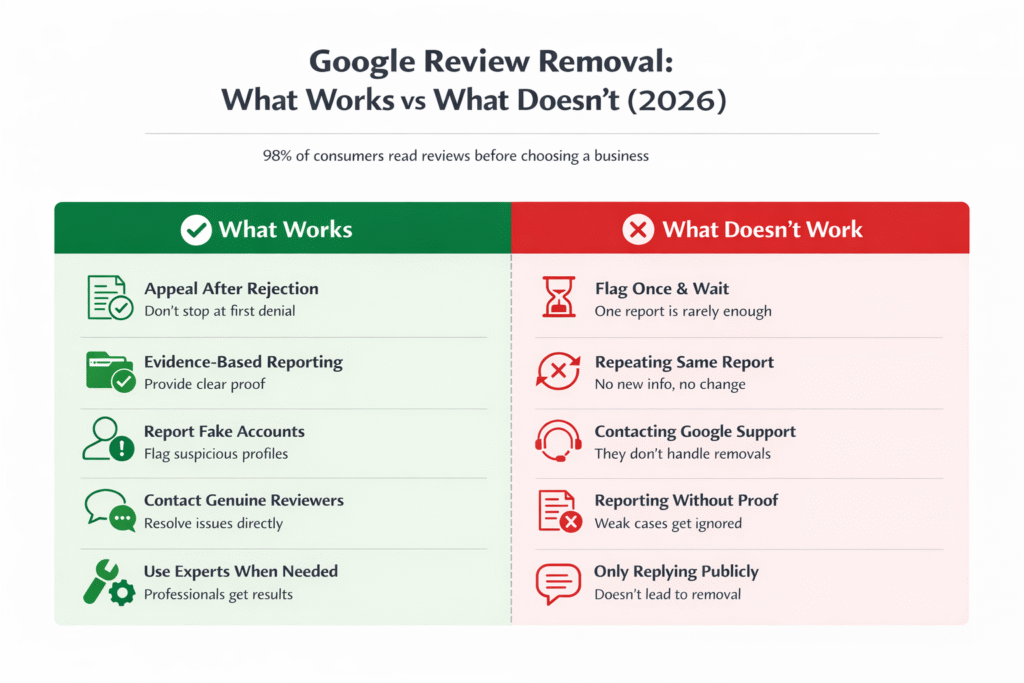
What Actually Works: The Methods That Get Results
There is no single path that works for every situation, and that holds true for internet content removal across platforms as well. The right method depends on the type of review, who posted it, and how clearly it violates Google’s policies. That said, some approaches consistently deliver better results than others.
Here are the methods that actually move the needle, in order of effectiveness:
1. Google’s Reviews Management Tool
This is the most direct route. You flag the review, select the violation type, and submit. If denied, you can file a formal appeal. Most businesses stop at the first denial. The appeal step is where results often happen.
2. Reporting the Reviewer’s Account
A fake account usually leaves traces. No profile photo, one or two reviews total, recently created. Reporting the account directly alongside the review gives Google more to work with when making a decision.
3. Direct Outreach to the Reviewer
Not every negative review comes from bad intent. Some customers are genuinely unhappy and willing to take the review down if the issue gets resolved. A calm, direct message addressing their concern is sometimes all it takes.
4. Working With a Google Review Removal Company
Most businesses that come to a Google review removal company have already tried everything else. The difference is knowing exactly how to frame a violation, what evidence Google responds to, and how to push a case forward when the standard process keeps hitting a wall.
What Doesn’t Work And Why Businesses Waste Time on It
Just as important as knowing the right methods is knowing which ones to stop relying on. A lot of businesses spend weeks on approaches that were never going to produce results. The time lost matters, especially when a damaging review is sitting live on your profile throughout.
1. Flagging a review once and waiting
Google processes a high volume of reports daily. A single flag with no supporting context rarely gets meaningful attention. Without a clearly documented violation, the default outcome is no action.
2. Responding to the review publicly
Writing a professional response is good practice for customer perception. It does not, however, prompt Google to remove anything. Many businesses confuse managing a review with removing it. These are two completely different actions. This confusion extends to other platforms too. Businesses trying to remove TikTok video content often make the same mistake of assuming a report alone is enough.
3. Contacting Google Support Directly
Google Support is not built for review disputes. Most representatives work through a fixed process and have no real access to removal decisions. Small and mid-sized businesses especially find that these conversations go nowhere and eat up time that could have been spent on something that actually moves the case forward.
4. Repeating the Same Report Multiple Times
Sending the same flag over and over without anything new behind it does not push things along. It can actually make your case look weaker. If the grounds have not changed and the documentation is the same, Google has no reason to respond differently the second or third time around.
| There is a clear gap between what businesses expect from Google review removal and how the process actually works. Success depends on identifying valid violations and presenting them correctly, not simply flagging content repeatedly. This distinction is what separates effective reputation management from wasted effort. |
| — Founder & CEO, MGMT Reputation |
How Does MGMT Reputation Handle Google Review Removal Where Others Fall Short?
Most businesses contact MGMT Reputation after weeks of going back and forth on their own, trying the same steps with no real movement. As a Google review removal company, MGMT Reputation offers broader content removal services with a clear, case-driven process built around what Google actually responds to. Here is what that actually involves:
- Case Assessment Before Action: Before anything gets reported, MGMT Reputation reviews the situation in full. This means the grounds are solid going in, and the chances of a straight denial are kept as low as possible.
- Documentation That Holds Up: Every case gets built around Google’s actual violation criteria. The evidence is put together in a way that makes sense to the people reviewing it on Google’s end.
- Monitoring After Removal: Once a review comes down, MGMT Reputation keeps an eye on your profile. Fake Google reviews sometimes come back, and catching that early makes a real difference.
- Current Knowledge of Google’s System: Google changes its guidelines more often than most people realize. MGMT Reputation stays on top of those changes, so your case is always handled the right way at the right time.
Stop Letting One Review Define Your Business.
Not every review can be taken down, and any service that promises otherwise is not being straight with you. But a large number of harmful, false, and policy-violating reviews do come down every day, for businesses that approach the process correctly. Knowing what works in Google review removal means understanding Google’s criteria, choosing the right method for your specific situation, and not wasting time on approaches that were never going to produce results.
MGMT Reputation has helped businesses across the country take back control of their Google profile, protect their rating, and stop losing customers to content they never deserved. If a damaging review is sitting on your profile right now, do not wait for it to sort itself out. Reach out to MGMT Reputation today and find out exactly what can be done about it.
FAQs
1. Does Google review removal actually work in 2026?
It does, but only when there is a clear policy violation behind the report. Flagging a review just because it hurt your rating rarely goes anywhere.
2. How long does the Google review removal process take?
It depends on the route you take. A basic flag can take anywhere from a few days to two weeks. Working with professionals usually moves things along faster because the case is built correctly from the start.
3. Can I remove fake Google reviews without legal action?
In many cases, yes. If the violation is clear and the report is backed with proper documentation, Google’s flagging and appeal process alone can get the review taken down.
4. What makes a Google review removal company worth hiring?
When you have already tried reporting, and nothing has moved, professionals know how to build a case that actually gets looked at. It is less about connections and more about knowing exactly what Google needs to see.
5. How do I know which reviews qualify for removal?
Spam, fake accounts, and conflict of interest cases tend to qualify. A real customer leaving a bad review based on their actual experience, even an unfair one, usually does not meet Google’s removal criteria.


