

Your Google results are your business card, your first impression, and your digital handshake all at once. Before a potential client calls you, an investor meets you, or a partner considers working with you, they’ve already searched your name. And what they find shapes every conversation that follows.
Yet in a booming $6.9 billion industry filled with hundreds of agencies making bold promises, choosing the wrong reputation management company can waste thousands of dollars and sometimes make your reputation problem worse. So how do you make the right call?
The short answer: match the company’s specialty to your specific problem, verify their methodology, and avoid anyone who promises instant miracles. This guide walks you through exactly how to do that with a practical vetting checklist, red flags to avoid, and a case study you can learn from.
| Did You Know? |
| Over 90% of consumers say a brand’s online reputation directly influences their purchasing decisions. One negative review can cost a business up to 30 potential customers. And a single additional star on Yelp has been shown to boost revenue by 5–9%. Yet most businesses don’t even know what shows up on page 2 of their Google results. Source: NewMedia.com, Reputation Management Statistics 2026 |
Key Takeaways
- Define your reputation issue first– The right solution depends on whether you’re dealing with reviews, SEO, PR, or AI-related problems.
- Choose a specialist, not a generalist– Industry-specific expertise leads to faster and more effective results.
- Focus on transparent methodology- A reliable reputation management consultant explains their strategy clearly without hiding behind “secret tactics.”
- Avoid unrealistic promises- No ethical company can guarantee instant removals or overnight reputation fixes.
- Think beyond Google- Modern ORM must include AI search optimization to control how platforms interpret and display your brand.
Why Choosing the Right Reputation Management Company Is So Critical in 2026
The online reputation management industry has matured rapidly. In 2025, it was valued at roughly $6.9 billion, with projections suggesting it will nearly double by 2030. But market growth hasn’t eliminated bad actors, it’s given them more places to hide.
In 2026, your reputation problem isn’t just about what ranks on Google. It’s about what AI platforms like ChatGPT, Gemini, and Perplexity are summarizing when someone asks about you. A single inaccurate AI overview, a misattributed quote, or a stale forum post feeding an AI response can be more damaging than a negative article because people believe AI answers without question.
That means the reputation management consultant you hire needs to understand not just SEO, but entity optimization, schema markup, factual consistency across trusted sources, and AI search visibility. Most agencies don’t. The ones that do are worth their price.
Step 1: Define Your Reputation Problem Before You Call Anyone
This is where most businesses go wrong. They call an agency before they’ve defined what, exactly, they’re trying to solve. The type of problem determines the type of solution and the wrong solution wastes both time and money.
Ask yourself which of these best describes your situation:
- Negative news articles or media coverage appearing in search results
- Fake, malicious, or unfair reviews on Google, Yelp, Glassdoor, or Airbnb
- Damaging forum posts, complaint site content, or old court records
- Poor overall Page 1 results that don’t reflect your true brand
- AI tools generating inaccurate summaries about you or your business
- An executive or personal reputation issue tied to your name, not a brand
Each of these requires a different specialist. A local restaurant battling a fake Google review campaign needs a different service than a CEO dealing with a damaging news feature from five years ago. Conflating them leads to wasted retainers and frustration.
Matching Your Problem to the Right Reputation Management Service
Use this reference table to align your specific situation with the type of reputation management consultant or service you should be seeking:
| What You Need | Service Type to Look For | Red Flag if Missing | Timeline |
|---|---|---|---|
| Negative news/articles | Content suppression + SEO | No case studies | 3–12 months |
| Fake/bad reviews | Review management & removal | Promises instant deletion | 30–90 days |
| Poor Google Page 1 | SERM + content creation | No keyword strategy | 6–12 months |
| Crisis/PR damage | Crisis PR + ORM hybrid | No 24/7 response plan | Immediate + 6+ months |
| AI summary errors | Entity SEO + schema fix | Unaware of AI overviews | 2–4 months |
| Executive reputation | Personal branding + thought leadership | No discretion/NDA | 6–18 months |
Step 2: Vet Their Methodology Not Just Their Portfolio
After identifying what kind of help you need, the next step is understanding how a company plans to deliver it. Methodology is everything. A polished case study doesn’t tell you whether the tactics used were ethical, sustainable, or replicable for your situation.
When you speak to any reputation management company, ask these direct questions:
- “Can you walk me through your process for a situation like mine, step by step?”
- “Are your SEO, content, and PR teams inhouse or outsourced?”
- “How do you handle AI search results and AI Overviews specifically?”
- “What do your contracts say about tactics, timelines, and escalation?”
- “Can I see case studies from clients in my industry or with a similar problem?”
Pay close attention to how they answer. Vague responses, proprietary ‘secret sauce’ language, or refusal to detail paid media costs are serious warning signs. The best reputation management companies explain their approach clearly because they have nothing to hide.
| Perspective from MGMT Reputation |
| “Reputation is not what you say about yourself, it’s what others find when they search for you. The right ORM partner doesn’t just bury the bad. They build a digital presence so authoritative, so consistent, and so well structured that the truth rises to the top on Google and in every AI platform that matters.” MGMT Reputation Team, |
Step 3: Know the Red Flags Before You Sign Anything
The ORM industry has its share of firms that overpromise, underdeliver, or worse use tactics that get you penalized by Google or open you to legal liability. Here are the nonnegotiable red flags:
- Guarantees of removing ‘every negative link’ no ethical firm can promise this
- Claiming their methods are ‘proprietary’ and refusing to explain them
- Hidden fees for PR wire services, priority support, or ‘platform access’
- Using fake reviews, bot farms, or scraping personal data as part of their strategy
- Contracts that ban you from discussing their tactics with third parties
- No clear escalation plan if results aren’t materializing after 90 days
One practical tip: Google the reputation management company itself. If industry forums accuse them of blackhat tactics or they have unresolved complaints on Trustpilot or the BBB, that’s your answer before you’ve spent a cent.
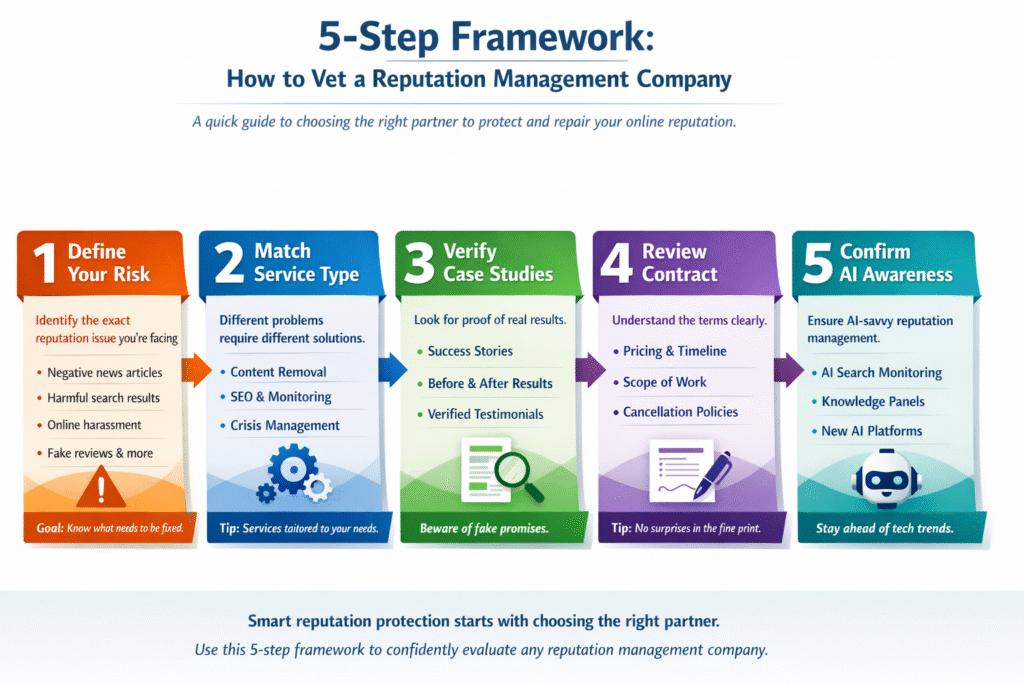
Your 8 Point Vetting Checklist for Choosing a Reputation Management Company
Before signing any agreement with a reputation management consultant, run through this checklist:
| Vetting Checkpoint | What to Look For |
|---|---|
| Proven Case Studies | Ask for industry specific results, not generic testimonials |
| Transparent Methodology | They should explain their approach in plain language |
| No Guaranteed Removals | Ethical firms promise effort, not magic outcomes |
| InHouse Team | Confirm SEO, PR, and content teams are not outsourced |
| AI Search Awareness | Do they optimize for ChatGPT, Gemini, and AI Overviews? |
| Clear Pricing | Line item pricing for tools, placements, and legal hours |
| Written Timeline | Risk factors and escalation triggers must be in the contract |
| NDA & Discretion | Critical for executives, medical, and legal professionals |
| RealWorld Case Study: Regional Law Firm Recovers from a Reputation Crisis |
| Background: A midsized regional law firm was losing client consultations after a disgruntled former employee posted a series of fabricated reviews across Google, Avvo, and Yelp, while also seeding a negative forum thread that appeared on page 1 of Google for the firm’s name. The Mistake: The firm initially hired a general digital marketing agency that promised ‘fast results.’ After three months and $4,500, the negative results had barely moved and a poorly written guest post the agency had published was now also appearing in search, making the situation look worse. The Right Move: The firm then engaged a specialist reputation management company that understood both legal sector ORM and Google’s review removal policies. Within 90 days, two of the fake reviews were removed under Google’s impersonation policy. A 6month content suppression and authority building campaign pushed the negative forum thread to page 3. New structured content attorney profiles, case result pages, and a thought leadership strategy rebuilt the firm’s Page 1 and fed accurate information into AI overviews. Key Lesson: Industry specific expertise isn’t a luxury, it’s the difference between a 3month result and a 12month stall. Match the specialist to the sector. |
Step 4: Understand Pricing Models And What’s Fair
Reputation management pricing varies enormously. Monthly retainers for ongoing ORM and monitoring typically range from $500–$5,000+ for small to mid businesses, while complex executive or crisis campaigns can run $2,000–$15,000 per month or more. Project based fees for specific content removal or review disputes are often priced separately.
What matters more than the number is what’s included. Ask for line item breakdowns that separate tool costs, content production, paid placements, legal review fees, and agency time. Any firm that bundles everything into one opaque monthly fee should be asked to unbundle it or avoided.
Payonsuccess models (like those used for specific content removals) can seem attractive, but they only work for targeted, defined problems. They’re not a substitute for a comprehensive strategy.
Step 5: Ask for Two Engagement Formats Then Compare
One of the most practical yet overlooked vetting tactics is requesting both a retainer option and a project based option from every shortlisted firm. How a company structures their proposals reveals how well they understand your specific problem and how honest they are about what’s required.
A firm that only offers long term retainers for a narrow, solvable issue may be padding their revenue. A firm that only offers project based work for a deep, systemic reputation problem may be underestimating the scope. The right company adapts their engagement model to your reality.
| Find the Right Reputation Management Consultant Starting Today Stop letting one bad article, a fake review, or an outdated search result cost you clients, opportunities, and revenue. The right reputation management company makes the difference between quietly fixing the problem now and having it follow you for years. ✔ Free Audit ✔ No Long Term Contracts ✔ Results Focused Strategy Get Your Free Reputation Audit |
How MGMT Reputation Helps You Choose Right and Get Results
At MGMT Reputation, we’ve built our practice around one principle: the right strategy only works when it’s designed for your specific situation, not a template applied to everyone.
We specialize in:
- Content removal & suppression for individuals, executives, and businesses
- Google Page 1 cleanup and authority building through ethical SEO and PR
- AI search optimization correcting what ChatGPT, Gemini, and AI Overviews say about you
- Review management for Google, Yelp, Glassdoor, Airbnb, and niche platforms
- Crisis reputation repair for businesses and public facing professionals
Unlike generalist marketing agencies, online reputation management services reputation is all we do. That focus means faster diagnoses, more precise strategies, and results that last. We start every engagement with a free, no obligation reputation audit so you understand exactly what you’re dealing with before committing to anything.
FAQs
1. How do I choose the best reputation management company?
Start by identifying your exact issue, then evaluate companies based on their expertise, transparency, and proven results. Avoid agencies that offer generic solutions or unrealistic guarantees.
2. Can a reputation management consultant remove negative content?
Some content can be removed if it violates platform policies, but most cases require suppression strategies like SEO and content creation to push negative results down.
3. How long does it take to fix an online reputation?
Timelines vary based on the issue. Minor review problems may take weeks, while larger SEO or PR challenges can take several months to show strong results.
4. What should I avoid when hiring an ORM company?
Stay away from firms that promise instant results, hide their methods, or use unethical tactics like fake reviews or bot-generated content.
5. Why is AI important in reputation management today?
AI tools now summarize online information, so inaccurate or outdated data can harm your image. Optimizing for AI search ensures your reputation is accurately represented everywhere.


