When was the last time you actually searched your own company name and looked at it the way a job candidate would? Most businesses put real effort into their hiring process, job posts, interviews, and offer letters. But the number of quality applicants keeps shrinking, and the people they do hire don’t stick around long. The problem usually isn’t the process. Understanding employer branding services why they matter is where most businesses fall short, and it’s costing them more than they realize.
| Did You Know? |
| According to LinkedIn, 88% of job seekers consider a company’s employer brand when deciding where to apply. |
What’s happening is pretty straightforward. Before a candidate ever clicks “apply,” they’ve already Googled your company. They’ve checked reviews, scanned search results, and maybe even come across a forum post about what it’s like to work there. Without a clear employer branding strategy in place, that research happens completely outside your control. MGMT Reputation works with businesses to fix exactly that, so the wrong content stops showing up before the right candidates leave.
Key Takeaways
- Candidates research a company online before they ever apply, and what they find directly affects whether they move forward or not.
- A weak employer brand quietly raises hiring costs through longer timelines, more ad spend, and higher turnover rates.
- Unanswered reviews, damaging search results, and outdated content are some of the most common and avoidable employer branding mistakes.
- A strong employer branding strategy brings in better applicants, shortens the hiring process, and improves how long new hires actually stay.
- The employer brand lives across platforms like Glassdoor, Google, Reddit, and LinkedIn, all of them outside a company’s direct control without active management.
- MGMT Reputation helps businesses take control of what candidates find online, from cleaning up search results to managing reviews across platforms.
What Do Candidates See When They Search Your Company Name?
Most hiring managers focus on what happens after someone applies. But why employer branding is important really comes down to what happens before that in the few minutes a candidate spends researching your company on their own.
What they find usually falls into one of these categories:
- Glassdoor reviews: Star ratings, anonymous complaints, and comments from former employees that candidates treat as ground truth
- Google search results: News articles, blog mentions, or forum threads that surface when someone types your company name
- Reddit and public forums: Unfiltered conversations about workplace culture, management, and salaries that rank surprisingly high in search
- Autocomplete suggestions: What Google auto-fills after your company name can itself signal a reputation problem
None of this is neutral. Candidates are reading all of it, forming opinions, and deciding whether to apply or move on to the next option. Most businesses have no idea this is happening, let alone what those results actually say.
Why a Poor Employer Brand Makes Hiring More Expensive
A weak employer brand doesn’t just hurt reputation, it quietly inflates hiring costs in ways that are easy to overlook until the numbers get hard to ignore. Fewer quality applicants means longer hiring timelines and more money spent on job ads to fill the same roles. The financial impact is real, even if it’s not always easy to trace back to the employer brand.
Here’s a simple breakdown of how it plays out:
| What Candidates Find Online | What It Costs Your Business |
| Negative Glassdoor reviews with no employer response | Good candidates back out before the first interview |
| Damaging search results or old news articles | Job ads cost more because organic interest is low |
| No positive content is showing up for the company name | Hiring takes longer and costs more per role |
| Big gap between the brand image and what the reviews actually say | New hires leave quickly, and the cycle repeats |
Investing in employer branding services at this point isn’t a marketing decision, it’s a cost-control option.
What are Common Employer Branding Strategy Mistakes Businesses Don’t Realize They’re Making
A lot of the damage to an employer’s reputation doesn’t come from one big incident. It builds up quietly through small, avoidable mistakes that go unnoticed until hiring starts to suffer. Skipping any of these is where an employer branding strategy starts to fall apart, quietly, and usually right when hiring matters most.
1. Set it and forget it: A careers page built two years ago is not an employer branding strategy. Candidates notice when nothing has been updated.
2. Ignoring what ex-employees are posting publicly: Resignation posts, Glassdoor reviews, and LinkedIn comments from former staff carry real weight with candidates. Leaving them unaddressed sends a message on its own.
3. Confusing brand popularity with employer reputation: Being a known brand doesn’t mean people want to work there. Product reputation and employer reputation are two completely different things.
4. Never Googling your own company name: Whatever shows up in those results is what candidates are reading. If you haven’t checked recently, it’s worth doing right now.
Case Study: How Siemens Fixed a Hiring Problem They Didn’t Create
Siemens was innovative and growing, but candidates saw it as old-fashioned and slow-moving. Even their own employees had little clarity on what the company stood for. Qualified tech talent was choosing Google and Apple instead, not because Siemens was a worse option, but because the wrong story was showing up first.
Siemens rebuilt their employer brand around a new message, “We make real what matters” and let real employees tell the story across multiple regions. They focused on changing what candidates actually found when they searched the company. The goal was simple: make sure the online narrative matched the real workplace.
Lesson: A strong employer brand only works if the right story shows up online. When Siemens got that right, time-to-fill dropped by 28% and saved an estimated $1.2M in 12 months. That is exactly where reputation management services make the difference, controlling what candidates find before they decide.
How Employer Branding Services Actually Impact Who Applies and Who Stays
Understanding why employer branding is important gets very real when you look at what actually changes when it’s done right. It directly affects the quality of people who apply and how long they stay once hired.
When a company’s online presence is clean, consistent, and positive, a few things happen naturally:
- Better applicant quality: When a company’s online presence is consistent and positive, candidates who are already a good cultural fit tend to apply on their own.
- Shorter screening time: Applicants who’ve researched the company and liked what they found come in informed, which cuts down the back and forth during hiring.
- Higher offer acceptance: Candidates who trust what they’ve seen about a company before interviewing are far more likely to say yes when the offer comes.
- Stronger retention: When the employer brand reflects what the job is actually like, new hires don’t feel misled and are less likely to leave within the first year.
Working with a reliable employer branding company makes all of this easier to achieve and maintain consistently.
Why Do Businesses Trust MGMT Reputation for an Employer Branding Strategy That Actually Works?
When candidates search for a company name, what they find either builds trust or kills interest, and most businesses have no control over which one it is. MGMT Reputation specializes in cleaning up and managing exactly what shows up in those searches, so the employer branding services a company puts out actually hold up under candidate scrutiny. Getting that online presence right is what separates businesses that consistently attract good hires from those that keep wondering why quality applicants aren’t coming through.
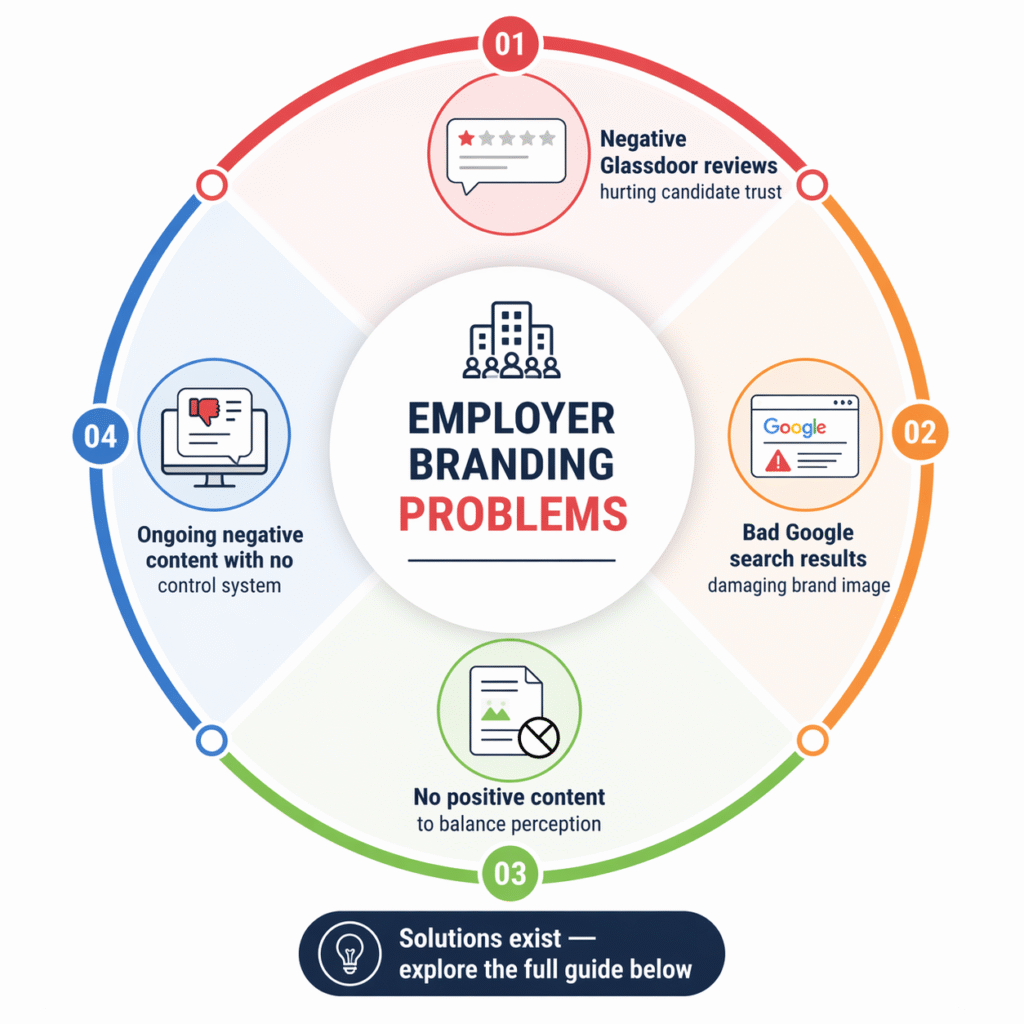
Problem: Negative Glassdoor reviews are dragging down candidate interest
Solution: MGMT Reputation works directly on review cleanup and employer response strategy, making sure what candidates read on Glassdoor reflects a workplace worth applying to.
Problem: Damaging search results are showing up when candidates Google the company
Solution: MGMT Reputation handles Google suppression and de-indexing so harmful content stops ranking where candidates are most likely to see it.
Problem: There is no positive content showing up to balance the narrative
Solution: MGMT Reputation builds out search presence with content that puts the right story in front of candidates before anything else gets a chance to shape their opinion.
Problem: New negative content keeps appearing with no system in place to catch it
Solution: With ongoing monitoring across platforms, MGMT Reputation acts as a reliable employer branding agency that catches damaging content early, before it starts affecting hiring numbers.
| Most businesses spend thousands on job ads and barely anything on what candidates find before clicking apply. That is backwards. Your search results are your first interview, and right now, a lot of companies are failing it without knowing. The good news is that this is fixable. That is the work we do every single day. |
| — Founder & CEO, MGMT Reputation |
Your Next Best Hire Is Already Googling You
An employer brand isn’t built in a boardroom or a quarterly HR meeting. It lives in search results, on review platforms, in forum threads, and across every piece of content a candidate finds before they ever decide to apply. Without a clear employer branding strategy in place, that content is working on its own and not always in the company’s favor.
MGMT Reputation helps businesses take back control of that narrative. From cleaning up damaging search results to managing what candidates find across review platforms, the work of a dedicated employer branding company is what keeps hiring pipelines healthy and retention numbers from quietly sliding. If the online side of your employer brand is already working against you, that’s not something to wait on. Reach out to MGMT Reputation today and get a clearer picture of what candidates are actually seeing when they search your name.
FAQs
1. What are employer branding services, and who needs them?
Any business that wants better hires and lower turnover needs a strong employer branding strategy to shape what candidates find online.
2. Why is employer branding important for recruitment?
When candidates search a company and find negative content, they move on, making hiring slower, harder, and more expensive than it needs to be.
3. How does an employer branding strategy help with employee retention?
Candidates who find honest, positive information about a company come in with the right expectations and are much less likely to quit early.
4. What does an employer branding agency actually do?
They fix and manage what shows up when someone Googles a company’s reviews, search results, and any content that could be turning candidates away.
5. How do I know if my employer branding company is the right fit?
Choose one that focuses on online reputation, search results, reviews, and ongoing monitoring, not just internal HR policies and culture programs.