
Most businesses spend years building trust, and a single search query can quietly undo a large part of it. Not through a lawsuit, not through a public scandal, but through a forum post on page one that nobody ever bothered to take down. The uncomfortable reality is that Google does not rank content by how accurate it is. It ranks it by how relevant and authoritative it looks. That is why following a step by step google search cleanup guide is not optional for businesses anymore.
What makes this harder for business owners is that most cleanup guides online are written for individuals dealing with personal content. Your situation is different. You are managing a brand name, a search footprint across multiple platforms, and customer perception all at once. At MGMT Reputation, we work with businesses that are tired of watching damaging content sit on page one while they have no clear plan to address it. Learning how to remove negative search results is the first step. Having a structured process behind it is what actually moves the needle.
| Did You Know? |
| A Harvard Business School study found that businesses with a 3-star rating earn up to 18% less revenue than those rated 5 stars, showing exactly how much damaging search content can cost a business over time. |
Key Takeaways
- Google search cleanup covers three actions: removal, suppression, and de-indexing. Knowing the difference saves weeks of wasted effort.
- Not every negative result qualifies for removal. Some can only be buried through a suppression strategy.
- The type of content and the platform it lives on determines which removal path you need to follow.
- Suppression works by pushing damaging results down with stronger, more authoritative content ranked above them.
- Starting removal requests and suppression campaigns at the same time gets you to results faster than doing them one after the other.
- MGMT Reputation handles the full cleanup process for businesses, from the first audit to long-term monitoring, so nothing gets missed.
What Does “Google Search Cleanup” Actually Mean for a Business?
Google search cleanup covers three distinct actions: removal, suppression, and de-indexing. Most businesses assume it is just about getting something deleted, and that misunderstanding is what leads to weeks of failed attempts and zero progress. Removing content from Google search is not a one-step process. Each track works differently, targets different types of content, and demands a different level of effort.
- Removal: The content is taken down entirely, either from the source website or de-indexed by Google, so it no longer appears in search results.
- Suppression: The content stays online but gets pushed down in rankings by stronger, more authoritative content that takes its place on page one.
- De-indexing: Google is instructed, through technical or legal means, to stop showing a specific URL in search results even if the page itself still exists.
Businesses that skip this distinction end up sending removal requests for content that was never eligible for removal in the first place and wasting weeks in the process.
What Kind of Content Is Actually Hurting Your Business on Google?
Before you take any action, you need to know exactly what you are dealing with. Different content types live on different platforms, get treated differently by Google, and require completely different approaches to remove unwanted search results from Google. This table gives you a clear starting point.
| Content Type | Where It Usually Lives |
| Fake or exaggerated negative reviews | Google Business Profile, Yelp, Trustpilot |
| Competitor-planted complaints | Reddit, forums, niche industry boards |
| Outdated or misleading news articles | Local news sites, press release directories |
| Glassdoor complaints and employer reviews | Glassdoor (often ranks high for brand name searches) |
| Negative autocomplete suggestions | Google Search itself |
| Defamatory TikTok videos and social content | TikTok, YouTube, Instagram |
| Background check results surfacing publicly | BeenVerified, Spokeo, people-search sites |
| Negative forum threads and blog posts | Reddit, independent blogs, WordPress sites |
The platform matters because it determines what options you actually have. Knowing where your problem lives before you act is not just helpful. It is the difference between resolving this in two weeks or watching it sit there for two months.
Can Every Negative Result Be Removed? (Here’s the Honest Answer)
Not everything on Google can be taken down, and any guide that tells you otherwise is not being straight with you. Google acts on specific categories of content, but the bar is clearly defined. Understanding this before you start saves businesses significant time and prevents the frustration of chasing removals that were never going to happen.
Here is how to think about it across three realistic categories:
- Yes, It Can Be Removed
Things like outdated pages, content that breaks Google’s policies, fake reviews, or anything that violates a platform’s terms. These have a clear removal path. It takes effort and follow-up, but it gets done.
- Depends on Who You Are Dealing With
Reddit posts, blog content, TikTok videos, and third-party articles fall here. Google will not remove these on its own. You need the site owner or platform to act. Even if you know how to remove search results from Google, it stops being straightforward and starts needing a real strategy.
- No Direct Removal, But It Can Be Buried
Accurate news articles, opinion pieces, and Glassdoor reviews rarely get taken down. No policy is being broken, so there is no removal ground. The only move here is pushing that content far enough down in Google rankings that most people never see it.
Most businesses are sitting with all three types at once without realizing it. Trying to handle each one through trial and error costs time your reputation does not have. That is where professional online reputation management services step in and make the process actually work.
Case Study: How Starbucks Turned Negative Search Sentiment Around in 2025
According to a July 2025 report in Entrepreneur, customers were unhappy with Starbucks over higher prices and poor service. They left negative reviews across multiple platforms and social media. All of this bad feedback started showing up when people searched the brand online.
Starbucks started monitoring what people were saying online in real time. They responded fast, fixed complaints, and published positive content to push bad results down. In six months, positive mentions went up 15% and negative ones dropped by 20%.
The Lesson: Waiting for reputation damage to fix itself is never a strategy. Professional monitoring and a structured response plan are what actually stop the bleeding.
The Step-by-Step Google Search Cleanup Process for Businesses
Follow this step by step google search cleanup guide in order. Each step builds on the last, and skipping any of them is what leads to wasted time and no real progress.
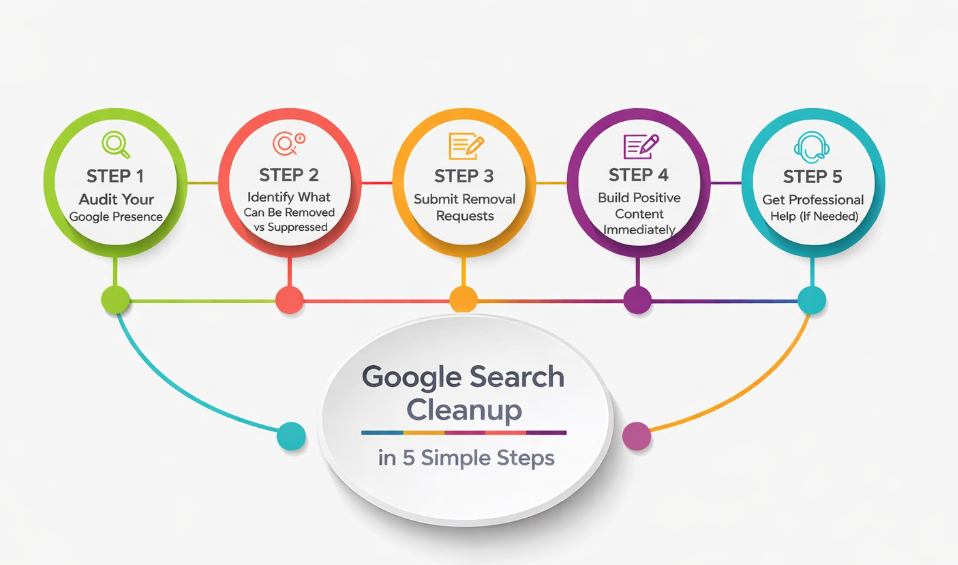
Step 1: Audit What Google Actually Shows About You
Search your business name the way a customer would, with words like “reviews,” “complaints,” and your city name added. Write down every result that concerns you, the URL, the platform, and what type of content it is.
Step 2: Sort Results by What Can Be Removed vs. Buried
Not every negative result qualifies for removal, and treating them all the same way wastes weeks. Use the category framework from the previous section to decide which results need a removal request and which ones need a suppression strategy.
Step 3: Submit Removal Requests Through the Right Channels
For content that qualifies, use Google’s Outdated Content Tool or the Results About You tool. For third-party content like fake reviews or TikTok videos, go directly to the platform and follow their specific reporting process to remove content from Google search results at the source.
Step 4: Push Positive Content Up While Removals Are in Progress
Do not wait for removal requests to clear before working on suppression. Publishing authoritative content around your brand name at the same time keeps things moving and starts shifting what people see on page one.
Step 5: Hand It Over to a Professional Team
The honest truth is that most businesses do not have the time or the technical knowledge to manage this process properly on their own. A professional team handles everything from audit to removal to suppression to monitoring, and gets it done faster with far fewer dead ends. That is where content removal services become less of an option and more of a practical decision.
Why Suppression Matters as Much as Removal
Removal is not always the finish line. For a large portion of the content that damages business reputations online, there is no removal option available. The content does not break any policy. It is just sitting there, ranking well, and doing quite damage every time someone searches your name. That is where suppression comes in, and most businesses completely underestimate how effective it is.
How does suppression work? Suppression works by building enough authoritative, positive content around your brand that the damaging results get pushed further down in Google rankings. The goal is not to erase the problem. It is to make sure that by the time someone reaches that negative result, they have already seen five stronger, more credible pages about your business first. Online reputation management services that only focus on removal and ignore suppression are only solving half the problem.
Here is what a working suppression strategy actually involves:
- Publishing optimized content on high-authority platforms that rank for your business name.
- Building out and maintaining professional profiles across LinkedIn, Google Business, and industry directories.
- Generate consistent positive reviews that push up overall search sentiment for your brand.
Suppression takes longer than a removal request. But for content that cannot be taken down, it is the only strategy that actually moves results off page one.
| Nine out of ten businesses that come to us have already tried the DIY route. The issue is never effort. It is that Google does not reward effort. It rewards strategy. Most people do not know what that strategy looks like until the results stop moving. We build that strategy from the ground up for every client we take on. |
| — Founder & CEO, MGMT Reputation |
How MGMT Reputation Handles Google Cleanup for Businesses
Most businesses reach out to us after spending weeks trying to manage this on their own, with little to show for it. MGMT Reputation works with businesses across the US to handle the entire cleanup process to remove content from Google search, from the first audit to long-term monitoring. This is not a one-size-fits-all service. Every case starts with understanding exactly what is ranking, where it is coming from, and what the realistic path forward looks like. Our content removal services are built around that specific situation, not a generic checklist.
1. Audit and Assessment: Every engagement starts with a full review of your search footprint. We identify every result that is hurting you, categorize it, and build a clear action plan before any work begins.
2. Removal and Suppression Execution: We handle direct removal requests, platform reporting, DMCA filings, and suppression campaigns simultaneously. Nothing waits on anything else.
3. Ongoing Monitoring and Protection: Once your search results are in a better place, we keep them there. Real-time alerts, monthly reports, and fast response to anything new that surfaces.
Damaging Content on Page One? Let’s Talk
Google search results are not static, and for businesses, leaving damaging content unaddressed is a decision that quietly costs leads, trust, and customers over time. Cleaning up your search presence is not a one-time task. It is an ongoing process that needs the right approach, the right tools, and consistent follow-through to actually hold.
MGMT Reputation works with businesses across the US to handle everything from content removal to long-term search monitoring under one roof. We know what works, what does not, and how to get results without wasting your time on dead ends. If damaging content is sitting on your page one right now, contact MGMT Reputation today for a confidential consultation.
FAQs
Q1. What is a step by step Google search cleanup guide for businesses?
It is a structured process that helps businesses find, remove, and suppress damaging content from Google search results in the right order.
Q2. Can I remove negative search results on my own?
Some results can be removed using Google’s tools, but third-party content often needs professional content removal services to handle it effectively.
Q3. How long does it take to remove unwanted search results from Google?
Timelines vary. Simple requests can resolve in days, while complex cases involving third-party platforms or legal routes take several weeks.
Q4. What is the difference between content removal and suppression?
Removal takes the content down completely. Suppression pushes it far enough down in rankings that most people never come across it.
Q5. When should a business consider online reputation management services? The moment damaging content starts showing on page one, waiting only makes it harder and more costly to remove content from Google search.