
That one article. That fake review. That angry post from three years ago sitting right there on Page 1 of Google, costing you customers every single day while you try to figure out what you can actually do about it.
Negative content on the internet does not fade on its own. It compounds. The longer it sits, the more it gets indexed, cached, scraped and syndicated across other sites making it progressively harder to remove and progressively more damaging to your reputation, your revenue and your relationships.
So, can you actually remove negative content from the internet? Yes but the method depends entirely on the type of content, where it lives and whether it violates platform policies or law. In 2026, there are five core removal routes: direct publisher outreach, platform policy takedowns, Google deindexing requests, legal action, and strategic suppression. This guide walks through every one of them with realistic timelines, what actually works, and when to bring in professionals.
| DID YOU KNOW? |
| 94% of consumers say they will avoid a business after reading a single negative review and that figure has been rising every year since 2020. Meanwhile, the click rate for anything below Position 10 in Google drops to just 1.05%. This means a negative result sitting anywhere on Page 1 is actively intercepting your customers before you ever get a chance to speak to them. |
| Source: ReviewTrackers 2025 Survey |
Key Takeaways
- Negative content does not disappear on its own and can continue damaging your reputation if left unaddressed.
- The best removal method depends on the content type, platform, and whether it violates policies or laws.
- Five main strategies include publisher outreach, platform reporting, Google deindexing, legal action, and SEO suppression.
- Google removal does not delete content but can significantly reduce visibility in search results.
- When removal is not possible, suppression can push negative results off page one and limit impact.
- Acting quickly improves success rates and prevents negative content from spreading across other sites.
Step 1: Identify What You Are Actually Dealing With
Before any removal strategy can be chosen, the content needs to be classified. Different content types have different removal routes and confusing them wastes time and often makes things worse.
| Content Type | Examples | Most Effective Removal Route |
| Fake or defamatory reviews | False Google, Yelp, Glassdoor reviews | Platform policy report + formal removal request |
| Negative news articles | Outdated press coverage, complaint features | Direct outreach to publisher + Google suppression |
| Defamatory social posts | Twitter/X threads, Facebook posts, Reddit | Platform report + legal takedown if defamatory |
| Personal data exposure | Name, address, phone on data broker sites | Google ‘Remove Personal Info’ tool + opt-out forms |
| Outdated/inaccurate content | Old blog posts, stale directory listings | Direct webmaster contact + Google Outdated Cache tool |
| Court records / mugshots | Mugshot sites, public record aggregators | Paid removal (site policy) + suppression strategy |
The 5 Core Methods to Remove Negative Content in 2026
These are not ranked in order of preference, they are ranked in order of what to try first. Work through each route systematically before escalating to the next.
Method 1 Contact the Author or Publisher Directly
This is the fastest route when it works, and it should always be your first move. Most websites have a contact page, editorial email or WHOIS-registered domain owner. Reach out professionally, explain the impact the content is having on your business or personal life, and request either a correction, update or full removal.
- Be factual, not emotional state specifically what is inaccurate or outdated
- Offer evidence: screenshots, documents, legal resolutions, or updated information
- For personal blogs or small sites, this succeeds more often than people expect
- For large news outlets, request a correction or right-of-reply first, then escalate
Timeline: 3 days to 3 weeks depending on responsiveness. Do not harass one professional follow-up is appropriate.
Method 2 Use Platform Reporting & Policy Takedowns
Every major platform has a content policy and negative content that violates it can be removed. This is the most direct route for fake reviews, defamatory social posts and content that breaches community standards.
- Google Reviews: report through Google Business Profile for fake, spam or policy-violating reviews
- Yelp: flag reviews through the business owner portal with a detailed written explanation
- Facebook/Instagram: use the three-dot report menu; repeat reports from multiple accounts escalate visibility
- Glassdoor: submit a formal flagging request with documented evidence of policy violations
- Reddit: report to moderators first, then escalate to platform admins for doxxing or defamation
Timeline: 7–21 days. Success rate is highest for content that clearly violates written platform policies.
Method 3 Submit a Google Deindexing Request
Google does not own the content it indexes but it does have tools to remove specific types from its search results. Even if the page itself cannot be taken down, removing it from Google eliminates 92% of its search visibility.
- Personal information: use Google’s ‘Remove Personal Info from Google Search’ form for contact details, financial data, government IDs and medical records
- Outdated content: use Google’s Outdated Content Removal tool to remove stale cached results
- NOINDEX tags: request the site owner add a NOINDEX meta tag Google will drop the page from its index within days
- GDPR right to erasure: EU residents can request deindexing of content referencing them under GDPR Article 17
Timeline: A few days to 4 weeks once submitted. This removes visibility, not the content itself; the original page remains live.
Method 4 Legal Action (Defamation, Copyright, Privacy)
When content is factually false and causes measurable harm, legal tools become available. This route takes longer but can achieve full removal that other methods cannot.
- DMCA Takedown: if the content uses your copyrighted images, text or video without permission, a DMCA notice forces platforms to remove it within 24–72 hours
- Defamation cease and desist: a formal letter from an attorney often results in voluntary removal without litigation
- Court order: for serious defamation cases, a court can mandate removal from both the site and Google’s index
- Privacy law (CCPA/GDPR): data brokers and aggregator sites must comply with removal requests under applicable privacy law
Timeline: DMCA: 24–72 hours. Cease and desist: 2–8 weeks. Full litigation: months to years. Reserve litigation for severe, persistent and quantifiably damaging content.
Method 5 Strategic Suppression (When Removal Is Not Possible)
Not all negative content can be deleted. News articles, legitimate reviews and opinions backed by free speech protections may be impossible to remove entirely. When that is the case, suppression pushing the content off Page 1 by outranking it with positive, authoritative content is the most effective long-term strategy.
- Publish authoritative blog content, press releases and guest articles targeting the same search queries
- Optimise and activate all social media profiles LinkedIn, Facebook, Instagram and Twitter rank for branded name searches
- Claim and populate all major business directory listings: Google Business, Yelp, Crunchbase, Better Business Bureau
- Build quality backlinks to positive content so it outranks the negative result
- YouTube videos appear in Google’s standard search carousel video content suppresses results extremely effectively
Timeline: 1–6 months. Content that drops below Position 10 on Google receives just 1.05% of total clicks effectively invisible.
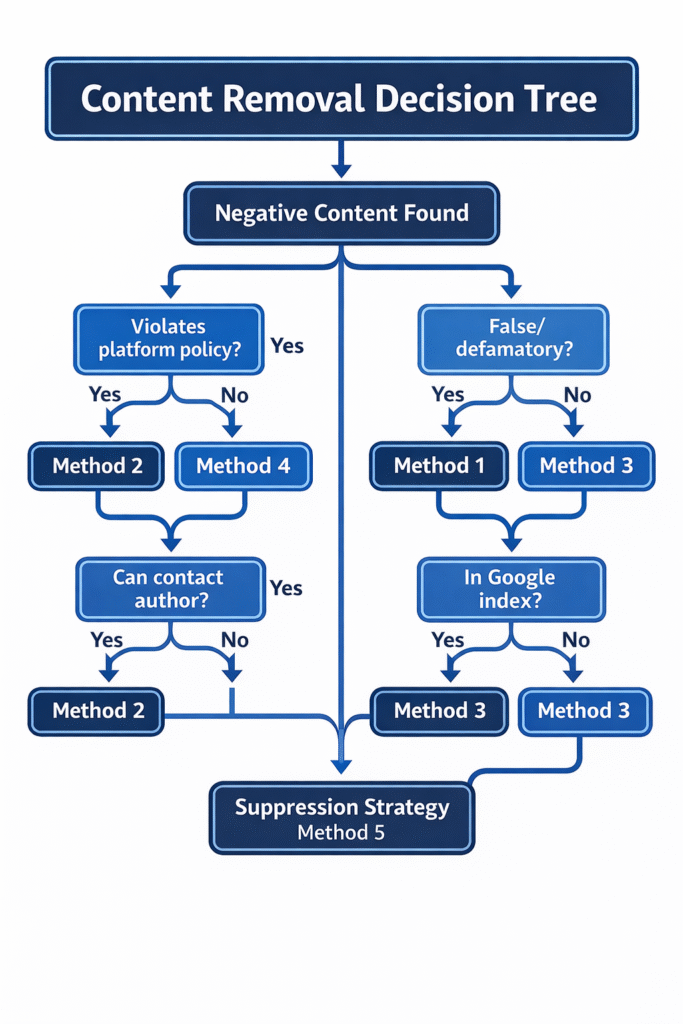
Realistic Removal Timelines at a Glance
| Method | Best For | Typical Timeline | Success Rate |
| Direct publisher contact | Blogs, small sites | 3 days – 3 weeks | Moderate – High |
| Platform policy report | Fake reviews, social posts | 7 – 21 days | High (for clear violations) |
| Google deindexing request | Personal data, outdated pages | Days – 4 weeks | High (for eligible content) |
| DMCA / legal takedown | Copyright, defamation | 24 hours – months | Variable – High with attorney |
| Suppression / SEO strategy | News articles, opinions | 1 – 6 months | High (long-term, permanent) |
| REAL-WORLD CASE STUDY |
| The Restaurant That Recovered From 47 Fake Reviews in 4 Months |
| A family-owned restaurant in Chicago noticed its Google rating dropping from 4.7 to 3.9 over a six-week period. Investigation revealed a coordinated campaign of 47 fake 1-star reviews posted from newly created accounts, all referencing a fabricated incident that had never occurred. Foot traffic had already declined by an estimated 22% based on table booking data. |
| The removal strategy was two-pronged. First, 39 of the 47 reviews were formally reported to Google with documented evidence of fake account behaviour; all 39 were removed within 18 days. The remaining 8, posted from older accounts, required a Google Legal Removal Request citing coordinated harassment. In parallel, a review generation strategy was activated: 120 verified legitimate reviews were collected over 90 days through a post-visit follow-up process. |
| Result: Rating recovered to 4.6 stars within 4 months. Foot traffic exceeded pre-attack levels by Month 5. The restaurant now has a monitoring system that flags suspicious review patterns within 24 hours of posting. |
| People ask me all the time can you guarantee you will remove this content? My honest answer is: it depends on what it is and where it lives. But here is what I can guarantee: we will find the path that gets you the closest to gone in the shortest possible time. And in the cases where full removal is not an option, we will make that content so invisible that your clients, your colleagues and your customers will never see it again. |
| Founder & CEO, MGMT Reputation |
4 Mistakes People Make When Trying to Remove Negative Content
- Sending angry or threatening messages to the author escalates the situation and often results in additional posts about your response.
Keep every communication strictly professional. The goal is resolution, not confrontation. A solicitor’s letter, if needed, will always outperform an emotional email.
- Trying to remove accurate, factual content through false DMCA claims this is illegal and can backfire severely.
Removal strategies only work for content that is false, defamatory, in violation of policy or infringing. Attempting to remove accurate criticism through false claims can result in counter-litigation.
- Ignoring the content and hoping it disappears on its own it will not.
Negative content, especially on high-authority domains, tends to gain indexing strength over time as other sites reference it. Early action is always more effective than delayed action.
- Attempting DIY removal for complex, multi-platform cases the time cost is massive and success rates for self-managed cases are significantly lower.
When content spans multiple platforms, involves legal violations or has been widely syndicated, professional expertise reduces both timeline and cost.
| Find Out If Your Negative Content Can Be Removed TodayStop losing customers to content you can actually remove. Our free content removal audit tells you exactly which results are eligible for takedown, which require legal action, and which need a suppression strategy and how long each will take. ✔ Free Content Removal Audit ✔ Platform-Specific Removal Plan ✔ Guaranteed ExecutionStart Your Free Removal Audit |
How MGMT Reputation Removes Negative Content for Individuals and Businesses
At MGMT Reputation, content removal is one of our most requested services and one we have refined across hundreds of cases spanning fake reviews, defamatory news articles, competitor attacks, mugshot sites, TikTok videos, Glassdoor complaints and more.
Our removal process follows a structured three-stage framework:
- Audit & Classification We map every piece of harmful content, identify which platform it lives on, assess its severity and categorise it by the most effective removal route.
- Removal Execution We execute removal attempts simultaneously across all applicable routes: direct publisher outreach, platform policy reports, Google deindexing requests and legal takedowns where warranted. This parallel approach cuts timelines significantly versus attempting routes sequentially.
- Suppression & Defence For content that cannot be fully removed, we build a targeted suppression strategy that ensures it drops off Page 1 within an agreed timeframe. We then install monitoring that alerts you the moment any new negative content appears about you online.
We serve business owners, executives, healthcare professionals, legal practitioners and public figures across New York, Chicago, Nashville, Seattle and across the US. Every case is assessed individually because no two removal situations are the same.Explore our content removal services or request a free audit and have one of our removal specialists review your specific situation within 24 hours.
FAQs
1. Can negative content be removed from the internet?
Yes. Negative content can be removed through publisher requests, platform reports, Google deindexing, legal takedowns, or suppression strategies.
2. How long does it take to remove negative content online?
Removal timelines vary. Some content can be removed in 24–72 hours, while others may take a few weeks or require long-term suppression.
3. What if the negative content cannot be deleted?
If removal is not possible, SEO suppression can push harmful results down in Google so they receive little to no visibility.
4. Can Google remove negative search results?
Google can remove certain content like personal information, outdated pages, or legal violations through official removal requests.
5. Are content removal services effective?
Professional content removal services improve success rates by using policy takedowns, legal options, and SEO strategies together.
6. What types of negative content can be removed?
Fake reviews, defamatory posts, personal data exposure, outdated content, and copyright violations are commonly removable.