
The article is three years old. The case was dropped. The facts were wrong. And it still sits on Page 1 of Google every time someone searches your name.
That is the particular cruelty of negative news online. Unlike a bad review or a social media post, a news article carries the weight of a real publication behind it: domain authority, backlinks, editorial trust all of which make Google rank it highly and keep it there, sometimes indefinitely, long after the moment it describes has been resolved.
Can you actually remove a negative news article from Google? Yes, in specific circumstances. And when full removal is not possible, you can suppress it so effectively that virtually nobody will ever see it again. This guide covers every method that works in 2026: contacting the publisher, requesting Google deindexing, using legal tools, and deploying a suppression strategy with realistic timelines, what to avoid, and the one critical mistake that makes things dramatically worse.
| DID YOU KNOW? |
| Businesses risk losing as many as 22% of customers when just one negative article appears in search results. If three negative articles show up, the potential for lost customers jumps to 59.2%. In fact, 94% of people say an online review has convinced them to avoid a business entirely. |
| Source: Qualtrics “Online Customer Review Statistics You Should Know“ |
Key Takeaways
- Negative news articles rank high on Google because trusted news websites have strong authority and backlinks.
- You can remove negative news by contacting the publisher, requesting deindexing, using legal options, or suppression.
- Google deindexing can remove an article from search results without deleting it from the website.
- Legal action works only when content is false, defamatory, or violates privacy — otherwise it may backfire.
- Suppression strategies can push negative news off Page 1 within weeks when removal is not possible.
Why Negative News Articles Are So Hard to Remove from Google
Before choosing a strategy, it helps to understand exactly why news articles dominate search results and resist removal. There are three compounding reasons:
- Domain authority: News sites like local newspapers, industry publications and national outlets carry enormous SEO authority because they attract thousands of inbound links. Google trusts them implicitly a new article from a news domain can outrank content that has existed for years on your own website within days of publication.
- Negative content drives clicks: Academic research consistently confirms that negative stories receive significantly more engagement than positive ones. More clicks signal to Google that the content is relevant and valuable so the algorithm actively promotes it rather than letting it fade.
- Syndication amplifies reach: Once a negative story is published, other sites pick it up. Blogs reference it, forums link to it, social media shares it. Each reference strengthens its domain authority further, making it progressively harder to displace even if the original article is removed or corrected.
Understanding these dynamics explains why most DIY removal attempts fail and why strategic, professional approaches are necessary for persistent, high-authority negative articles.
The 4 Methods to Remove Negative News Articles from Google in 2026
Work through these methods in order. Each escalates in complexity and time commitment. The first method is always worth attempting before moving to legal or technical routes.
Method 1 Contact the Publisher or Journalist Directly
This is both the simplest and most underused approach. Most people assume news outlets will refuse removal requests outright but that assumption is wrong far more often than people think, particularly when the facts have changed since publication.
What actually gets articles removed or updated:
- Charges that were dropped, expunged or never proceeded to conviction
- Civil cases that were settled, dismissed or resolved in your favour
- Factual inaccuracies that can be documented with official records
- Personal information included without consent in jurisdictions with right-to-erasure protections
- Outdated information that now misrepresents a materially different situation
Contact the managing editor directly not the original journalist. Prepare a factual brief with supporting documentation. Offer to provide a right of reply or updated statement that gives them editorial value in exchange for a correction or deindexing. Many regional and mid-tier publications comply within two to three weeks when approached professionally.
Timeline: One to four weeks. Success rate is significantly higher than most people expect especially for local publications, trade press and smaller digital outlets.
Method 2 Request Google Deindexing (Remove From Search Without Deleting the Article)
Deindexing removes a page from Google’s search results without deleting the original article from the publisher’s website. The article still exists it simply becomes invisible in Google. For most people dealing with negative news coverage, this outcome is effectively as good as full deletion.
Google’s official removal tools that apply to news content:
- Remove Personal Information from Google Search: Applicable for articles containing your home address, phone number, financial account details, government ID numbers or medical information. Google has significantly expanded the scope of this tool since 2023.
- Outdated Content Removal Tool: If the article has been deleted by the publisher but still appears in Google’s cache, this tool removes the cached version from search results within days.
- NOINDEX request: If you can persuade the publisher to add a NOINDEX meta tag to the article, Google will drop it from its index within days of the next crawl. This is often the most achievable compromise when outright deletion is declined.
- GDPR Right to Erasure (EU residents): Under Article 17, EU-based individuals can request deindexing of content that is no longer relevant, accurate or in the public interest. Google processes these requests and complies with eligible ones.
Timeline: Days to four weeks from submission. Deindexing is not guaranteed Google approves requests only when specific policy criteria are met. Thorough documentation dramatically improves approval rates.
Method 3 Legal Action (When Content Is Defamatory, False or Privacy-Violating)
Legal routes are the most powerful and the most frequently misused. They work well in specific circumstances and backfire badly when applied to the wrong situations.
When legal action is appropriate:
- The article contains provably false statements of fact presented as truth (defamation standard in the US and UK)
- The publication used your copyrighted photographs, video or written content without permission triggering DMCA takedown rights
- The article reveals private information you had a reasonable expectation to keep private
- The publication refused to correct factual errors after being provided with clear evidence
When legal action will backfire:
| THE STREISAND EFFECT A REAL RISK |
| Filing a defamation lawsuit against a journalist or publication almost always generates significant new press coverage of the lawsuit itself. This compounds the visibility of the original article, attracts additional outlets to cover the story, and typically results in more negative content on Page 1 than existed before. Legal action should be a last resort for severe, quantifiably harmful content not a first response to uncomfortable but accurate coverage. |
Timeline: DMCA notices resolve in 24–72 hours. Cease and desist letters: 2–8 weeks for voluntary compliance. Full litigation: 6 months to several years. Engage an attorney specialising in online defamation before taking any legal action.
Method 4 Google Suppression Strategy (Push the Article Off Page 1)
When full removal or deindexing cannot be achieved, suppression is the definitive solution. A properly executed suppression strategy makes a negative article so invisible in search results that the practical impact on your reputation becomes negligible.
The target: if content drops below Google position 10, it receives just 1.05% of total clicks for that search query. Below position 20, it is functionally invisible.
- Publish authoritative long-form content targeting the same name-based or brand-based search queries the negative article ranks for
- Optimise and activate all social media profiles LinkedIn, Facebook, Instagram and YouTube channels rank natively in Google for branded name searches
- Secure and optimise all major business directory profiles: Google Business Profile, Crunchbase, Bloomberg, Better Business Bureau, Wikipedia (where eligible)
- Publish press releases through newswire services AP News, Business Wire and PR Newswire content ranks consistently on Page 1 for branded searches
- Earn coverage in alternative publications a positive profile in an industry trade magazine or local business journal can outrank a negative article if it comes from a domain with comparable authority
- YouTube is a suppression weapon: a well-optimised video about you or your company appears in Google’s standard search results and competes directly against news article rankings
Timeline: 4–12 weeks for meaningful Page 1 displacement, depending on the authority of the negative article. Results are permanent when the underlying content programme continues.
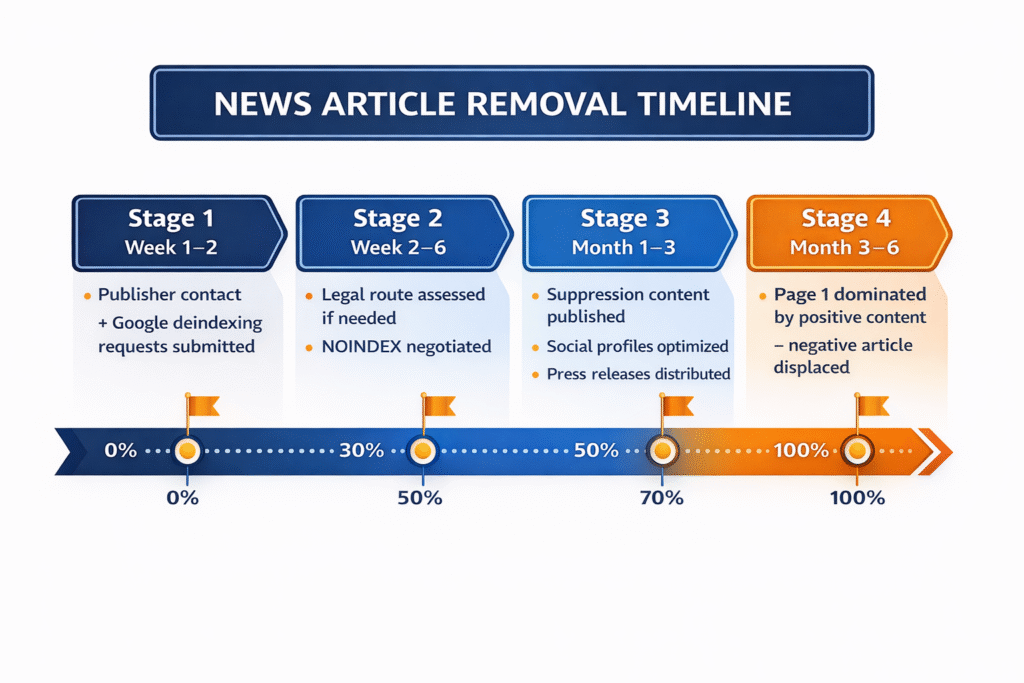
Which Method Is Right for Your Situation?
| Your Situation | Best First Method | Timeline | Backup Strategy |
| Article contains factual errors | Contact publisher directly | 1–4 weeks | NOINDEX request + suppression |
| Article is accurate but outdated | Publisher contact + Google Outdated Content Tool | 1–3 weeks | Suppression strategy |
| Article exposes private personal data | Google Personal Info Removal Form | Days to 4 weeks | Legal route (privacy law) |
| Article is defamatory / provably false | Cease and desist + DMCA if applicable | 2–8 weeks | Publisher negotiation + legal filing |
| Article is accurate removal not possible | Full suppression strategy | 4–12 weeks | Ongoing content + monitoring programme |
| Multiple articles across syndicated sites | Professional reputation management | 3–6 months | All 4 methods executed in parallel |
| REAL-WORLD CASE STUDY |
| The Executive Whose 4-Year-Old Arrest Article Was Blocking Six-Figure Contracts |
| A senior business executive came to us with a regional news article from 2021 that detailed an arrest. The charges had been fully dropped no conviction, no plea, no further proceedings. But the article had never been updated, still appeared in Position 2 for his full name on Google, and had cost him three separate consulting contracts that were verbally confirmed before due diligence surfaced the article. |
| We took a two-track approach simultaneously. Track 1: We contacted the regional newspaper’s digital editor directly with court documentation showing the case dismissal. After two weeks of professional correspondence, the publication agreed to add a prominent update noting the charges were dropped and to add a NOINDEX tag to the original article. Google removed it from search results within 11 days of the tag being applied. |
| Track 2: While waiting on the publication, we launched a suppression campaign targeting his name-based search queries LinkedIn profile optimisation, a professional bio on his company website, two industry press releases and a contributed article in a trade publication. By the time the NOINDEX was applied, three positive results had already reached Page 1. |
| Result: Article removed from Google within 6 weeks of engagement. All positive content stable on Page 1. First new consulting contract signed within 10 weeks. The client now has an ongoing monitoring system that alerts him within hours if any new content containing his name appears online. |
| News articles are the hardest category of negative content we deal with and also the most important to get right. The mistake I see people make constantly is going straight to lawyers, which turns a manageable situation into front-page news. Most of the time there is a quieter, faster and far more effective path available. You just need to know which doors to knock on first, and exactly how to knock on them. |
| Founder & CEO, MGMT Reputation |
3 Things That Will Make a Negative News Article Worse
- Filing an aggressive lawsuit as a first move this is the Streisand Effect in action. Litigation against a news outlet generates immediate new coverage, amplifies the original article’s visibility and often results in additional negative stories that are harder to suppress than the original.
Always exhaust direct outreach and deindexing routes before considering legal action. Reserve litigation for cases where harm is severe, ongoing and where the content is provably false.
- Posting aggressive rebuttals in the comments section of the article this adds fresh content to the page, signals renewed engagement to Google’s algorithm and increases the article’s ranking strength.
If you want to respond publicly, do it on your own platform your website, your LinkedIn, your press releases. Never feed Google’s engagement signals on the negative article itself.
- Waiting and hoping the article will naturally fall off Page 1 the freshness algorithm does not work in your favour for news articles from authoritative domains. Without active intervention, a negative news article can hold its position for three to five years or more.
The longer harmful content sits unchallenged, the more it gets referenced, shared and cached. Early action consistently produces faster, cheaper results than delayed intervention.
| Get That News Article Off Page 1 Starting This WeekOur free news article audit tells you whether your article is eligible for removal, deindexing or suppression and gives you a specific action plan with realistic timelines before you spend a penny. ✔ Free Article Eligibility Audit ✔ Publisher Contact Templates ✔ Custom Suppression Roadmap Request Your Free Article Removal Audit |
How MGMT Reputation Removes News Articles for Individuals and Businesses
Negative news article removal is one of the most complex services in online reputation management and one of the most critical to get right. At MGMT Reputation, we have worked with executives, business owners, medical professionals, legal practitioners and public figures across the US who needed news articles removed, deindexed or suppressed from Google search results.
Our news article removal process is built on four decades of combined experience negotiating with publishers, navigating Google’s removal policies, and executing suppression strategies that permanently alter what appears on Page 1:
- Publisher Negotiation: We contact editorial teams directly using professional frameworks that have produced removal or NOINDEX outcomes in cases that clients had previously attempted and failed on their own.
- Google Deindexing Management: We prepare and submit formally documented removal requests that meet Google’s specific evidentiary standards dramatically improving approval rates over self-submitted requests.
- Legal Coordination: Where legal routes are appropriate, we work alongside defamation attorneys and privacy lawyers to identify the specific legal basis for removal and execute without triggering the Streisand Effect.
- Permanent Suppression: When removal is not achievable, we deploy a full suppression campaign targeting the exact search queries the negative article ranks for replacing it on Page 1 with controlled, positive content.
We serve clients across New York, Chicago, Nashville, Seattle and across the US. Every case receives an individual assessment because no two articles, publications or situations are alike.Explore our news article removal services or request a free audit today and have a specialist review your specific article within 24 hours.
FAQs
Q1. Can negative news articles be removed from Google?
Yes. Negative news articles can be removed by contacting publishers, requesting Google deindexing, legal takedowns, or using suppression strategies.
Q2. How long does it take to remove a negative news article?
It can take a few days for deindexing, 1–4 weeks for publisher updates, and 4–12 weeks for suppression strategies.
Q3. What if a news article is true but outdated?
You can request an update, ask for NOINDEX, or use suppression to push the outdated article off Page 1.
Q4. Does Google delete news articles completely?
Google usually does not delete content. It may remove the article from search results through deindexing if it meets policy requirements.
Q5. What is the best method if removal is not possible?
A suppression strategy is the best option. It pushes negative news down in search results so fewer people see it.