Your next top hire just Googled your company. What they found in the next 30 seconds will determine whether they apply or close the tab.
In today’s hyper-competitive talent market, two forces control that verdict: your employer brand and your online reputation. Most business owners use these terms interchangeably. That’s a costly mistake. Employer branding and reputation management are two distinct disciplines and confusing one for the other means you’re either building a beautiful house on a cracked foundation, or patching cracks while ignoring the curb appeal entirely.
The short answer: Employer branding is what you intentionally project as a place to work. Reputation management is what the internet says about you and your effort to shape and control it. One is a strategy; the other is a discipline. You need both, but they operate differently, serve different purposes, and solve different problems. That’s why many companies partner with an employer branding agency to strategically craft their workplace image while actively managing their online reputation.
| Did You Know? 86% of job seekers research company reviews and ratings before applying for a role (Glassdoor, 2025). And 81% of candidates even when unemployed say they would refuse to join a company with a bad online reputation. Your reputation is not just marketing. It is a top-of-funnel talent filter. |
Key Takeaways
- Employer branding and reputation management are not the same. Employer branding shapes how you present your workplace, while reputation management controls what people actually see online.
- Employer branding is proactive, reputation management is proactive + reactive. One builds your hiring story, the other protects and repairs it.
- Candidates research before applying. Most job seekers check reviews, ratings, and search results before deciding to apply.
- Misalignment damages hiring performance. A strong employer brand fails if reviews, news, or employee feedback contradict your messaging.
- Best results come from using both together. Reputation management builds trust, while employer branding converts that trust into applications.
What Is Employer Branding?
Employer branding is the strategic, long-term process of defining and communicating what makes your company a great place to work. The concept was introduced by Ambler and Barrow (1996), who defined it as the ‘package of functional, economic, and psychological benefits provided by employment and identified with the employing company.’
In plain terms: your employer brand is your promise to potential and current employees. It answers the question every job seeker is silently asking: ‘Why should I work here, and not somewhere else?’
Employer branding operates on three benefit layers:
- Functional benefits — career development, learning opportunities, role variety
- Economic benefits — compensation, perks, financial security
- Psychological benefits — sense of purpose, belonging, culture, leadership quality
The core tool of employer branding is the Employee Value Proposition (EVP) , a clear articulation of what employees gain in exchange for their skills, time, and effort. According to Universum’s 2025 employer branding data, AI-driven recruitment, DEI commitments, sustainability, and work flexibility are now the defining pillars of a competitive EVP. Critically, work-life balance has overtaken salary as the top global motivator (83% vs 82%) meaning your EVP must reflect what talent actually values today.
What Is Reputation Management?
Reputation management is the practice of monitoring, influencing, and protecting how your company is perceived across online channels, search results, review platforms like Glassdoor and Indeed, social media, and news coverage.
Unlike employer branding, reputation management has both a proactive and reactive dimension. Proactive reputation management involves consistently publishing positive content, managing your review profiles, and building a strong digital footprint before crises hit. Reactive reputation management kicks in when negative reviews, bad press, or damaging content surfaces requiring damage control, content suppression, and strategic response.
RepTrak data shows that a one-point increase in a company’s reputation score yields a 2.1% increase in market cap. Glassdoor confirms: employers who improved their rating by just 0.5 stars saw 20% more job clicks and 16% more apply-starts. Reputation is not a soft concept, it is a hard business metric with direct financial impact.
| MGMT Reputation Insight: “Most companies come to us after the damage is done — a wave of negative Glassdoor reviews, a viral employee complaint, a toxic culture story in the press. What they really needed was to start before any of that happened. Reputation management is not a fire extinguisher. It is the smoke alarm.” — MGMT Reputation Team |
Employer Branding vs. Reputation Management: Side-by-Side Comparison
| Dimension | Employer Branding | Reputation Management |
|---|---|---|
| Definition | Proactively shaping your identity as an employer to attract & retain talent | Monitoring, repairing, and protecting brand perception online |
| Focus | Attraction & retention of employees | Damage control & online perception |
| Approach | Proactive — builds before problems arise | Reactive + Proactive — responds to threats |
| Owned By | HR, Talent Acquisition, Marketing | PR, Communications, Leadership |
| Tools Used | EVP, careers pages, Glassdoor profiles, social media | Review responses, content suppression, crisis comms |
| Audience | Job seekers, current employees | Customers, investors, media, job seekers |
| Timeline | Long-term, ongoing brand building | Ongoing + crisis-driven response |
| Success Metric | Cost-per-hire, retention rate, offer acceptance | Sentiment score, SERP visibility, review ratings |
Where They Overlap and Why That Matters
Here is the nuance most articles miss: employer branding and reputation management are not competing strategies. They are complementary and in 2025-2026, they are increasingly inseparable.
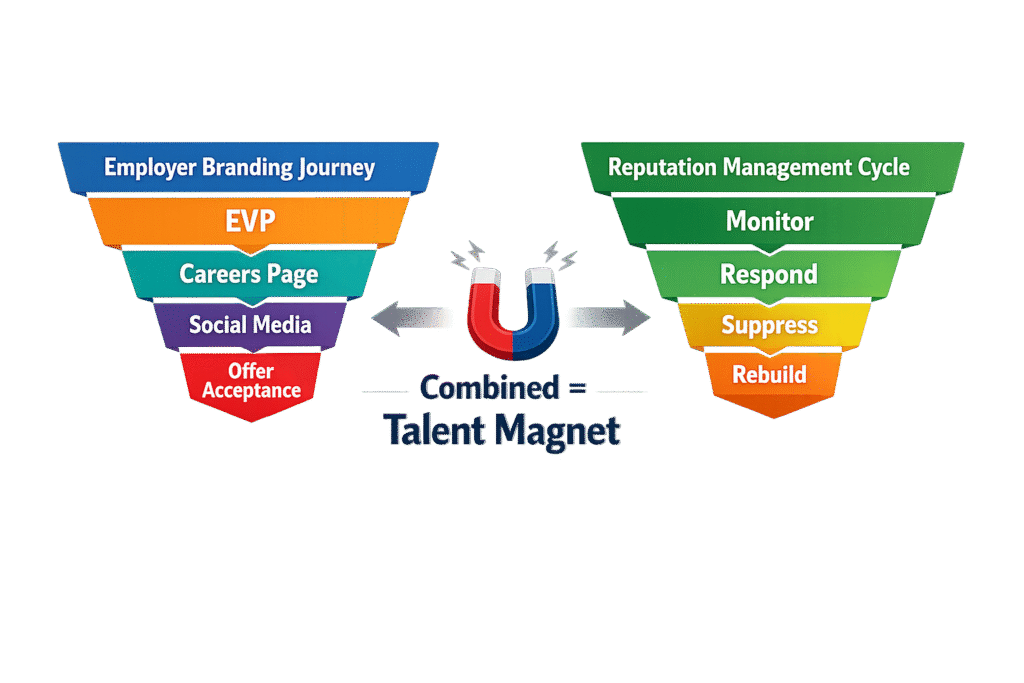
Your employer brand sets the intended perception (‘We are an innovative, people-first company’). Your reputation is the lived perception (‘My manager was terrible and HR ignored it’ Glassdoor, 1 star). When both are aligned, you become a talent magnet. When they are misaligned, your employer brand becomes noise that candidates dismiss because the review data tells a different story.
Research published in Frontiers in Sociology (2024) found that five dimensions of employer branding have a direct, significant positive relationship with an organization’s image and reputation — and that reputation, in turn, directly drives a job seeker’s intention to apply. In other words: strong employer branding builds reputation. And a well-managed reputation amplifies employer branding results.
Real-World Case Study: When Branding and Reputation Work Together
SaaS Company Turns Glassdoor Crisis Into a Hiring Advantage
A mid-size SaaS company noticed a 34% drop in application volume over six months. Their Glassdoor rating had fallen from 3.8 to 2.9 stars, driven by a cluster of negative reviews following a restructuring round. Their employer brand messaging (‘Join a culture of innovation’) was being directly contradicted by employee reviews citing poor communication and lack of transparency.
They implemented an integrated employer branding and reputation management strategy:
- Reputation triage: professionally responding to every negative Glassdoor review within 48 hours
- Content rebuild: publishing authentic employee spotlight videos and Day-in-the-Life content on LinkedIn
- EVP overhaul: repositioning their employer brand to honestly acknowledge the restructuring while emphasizing new commitments
- Review generation: encouraging recent positive hires to share authentic experiences on Glassdoor and Indeed
Result: Within 5 months, their Glassdoor rating recovered to 3.6. Application volume rose 41%. Cost-per-hire dropped 22%. The lesson: reputation management created a clean slate. Employer branding built a compelling story on top of it.
Which One Does Your Business Need Right Now?
Use this quick diagnostic to prioritize your investment:
| You Need Employer Branding If… | You Need Reputation Management If… |
|---|---|
| You struggle to attract quality applicants | You have negative reviews on Glassdoor or Indeed |
| Your careers page is outdated or uninspiring | Negative news or articles appear in search results |
| Candidates choose competitors despite competitive pay | Employees/ex-employees are posting damaging content |
| You have no defined EVP or culture messaging | Your application volume has dropped without explanation |
| You are scaling quickly and need a talent pipeline | Company went through layoffs, controversies, or bad press |
Best practice for 2026: run both simultaneously. The companies winning the war for talent are not choosing between employer branding and reputation management, they are integrating them into a single, unified talent attraction strategy.
How MGMT Reputation Helps Employers Win on Both Fronts
At MGMT Reputation, we specialize in the intersection of employer branding and reputation management because we know that one without the other leaves your company exposed in today’s talent market.
Our employer reputation services include:
- Employer Brand Audit — a full diagnostic of how your company appears to job seekers across all digital touchpoints
- Glassdoor & Indeed Reputation Management — professional review response, review generation campaigns, and negative review suppression strategies
- Employer Branding Strategy — EVP development, careers page optimization, and social employer brand content creation
- Reputation Monitoring — 24/7 alerts so you know the moment your employer brand is being discussed online
- Crisis Response — rapid-response reputation repair for companies dealing with negative press, viral content, or employee backlash
Whether you are a fast-scaling startup building your employer brand from scratch, or an established company recovering from a reputation setback, MGMT Reputation builds a strategy that makes the employer candidates choose not the one they avoid.
| Stop Losing Top Talent to a Weak Employer Brand Whether you need to build your employer brand from scratch, suppress negative Glassdoor reviews, or protect your reputation during a hiring surge MGMT Reputation has a proven playbook for it. Attract better candidates | Reduce cost-per-hire | Protect your employer brand 24/7Book a Free Employer Brand Audit |
Ready to Attract Top Talent and Protect Your Employer Brand?
Your ideal candidates are researching you right now. What they find on Google, on Glassdoor, on LinkedIn will determine whether they apply or walk away. The employer branding agency you partner with today determines the talent pipeline you build tomorrow.
Do not leave your first impression to chance. Partner with MGMT Reputation to build a talent-attracting employer brand and a bulletproof online reputation that works for you 24/7.
FAQs
1. What is the difference between employer branding and reputation management?
Employer branding focuses on promoting your company as a great place to work, while reputation management focuses on monitoring and improving how your company is perceived across reviews, search results, and online content.
2. Which is more important for hiring: employer branding or reputation management?
Both are equally important. Employer branding attracts candidates, but reputation management ensures negative reviews or bad press don’t discourage them from applying.
3. Can employer branding work if my company has negative reviews?
Employer branding becomes less effective if negative reviews dominate search results. Reputation management should be implemented first to improve trust and credibility.
4. How does online reputation impact recruitment?
Candidates often research company reviews, Glassdoor ratings, and search results before applying. A poor reputation can reduce applications, increase cost-per-hire, and hurt offer acceptance rates.
5. Should companies invest in employer branding and reputation management together?
Yes. The most effective hiring strategies combine both. Reputation management builds credibility, while employer branding communicates your culture and value proposition to attract talent.