
A bad article sitting on the first page of Google can quietly push people away before you even get a chance to speak for yourself. It does not matter if it is outdated, one-sided, or completely false. If it shows up when someone searches your name or your business, it is doing damage. Most people start looking into how to remove negative articles from internet searches only after they have already felt the impact, a lost client, a deal that went cold, or a conversation that never happened.
The good news is that removal is not always out of reach. But it is also not as straightforward as most people expect. There is a right way to go about it, and there is a wrong way that makes things harder to fix later. MGMT Reputation works with businesses and individuals navigating exactly this, and the starting point is always understanding what you are actually dealing with. This blog breaks down what the process actually looks like, why removing negative search results is not as simple as sending one request, and what actually gets results.
| Did You Know? |
| Search results can directly influence people’s decisions and opinions by up to 20% or more, simply based on what appears first. |
What Is a Negative Article on Page One Actually Costing You?
Most people only figure out something is wrong after the damage is already done. A client stops responding. A deal falls through. An opportunity disappears. That article sitting on page one of Google is not harmless. It is actively working against you every single time someone looks you up.
- Lost clients before first contact: Most people search your name before they ever reach out, and if something negative shows up first, a large number of them simply move on.
- Missed deals and partnerships: Investors, partners, and collaborators all do their research online before committing to anything, and one bad result is often enough to change their mind.
- Rejections you never even hear about: You do not get a no. You just never hear back, and you never find out why.
- AI tools are making it worse: Platforms like ChatGPT and Gemini now pull information from the same sources that rank on Google, which means that negative articles may be showing up in AI answers, too.
- Waiting makes everything harder: The longer that article stays up, the more it gets picked up by other websites and cached across the internet, which is exactly why the decision to remove negative content from the internet should not be put off.
When One Article Became a Crisis: The Kellogg’s Reputation Lesson
In February 2024, WK Kellogg’s CEO suggested families eat cereal for dinner to save money. The comment was clipped and shared across social media within days. Negative articles spread fast, a boycott was organized, and the brand’s reputation took a serious hit.
Kellogg’s went completely silent, no statement, no apology, no public response. That silence gave the negative articles more room to spread. The story kept growing because nothing was done to contain it early.
Lesson: One article left unaddressed can define your brand before you get a chance to respond. Professional online reputation repair services exist for exactly this reason to step in before the damage becomes too deep to fix.
Why Is Removing a Negative Article Harder Than It Sounds?
Most people assume that Google search cleanup is just a matter of sending a request or flagging it somewhere. In reality, it is a lot more complicated than that, and understanding why is the first step to approaching it correctly.
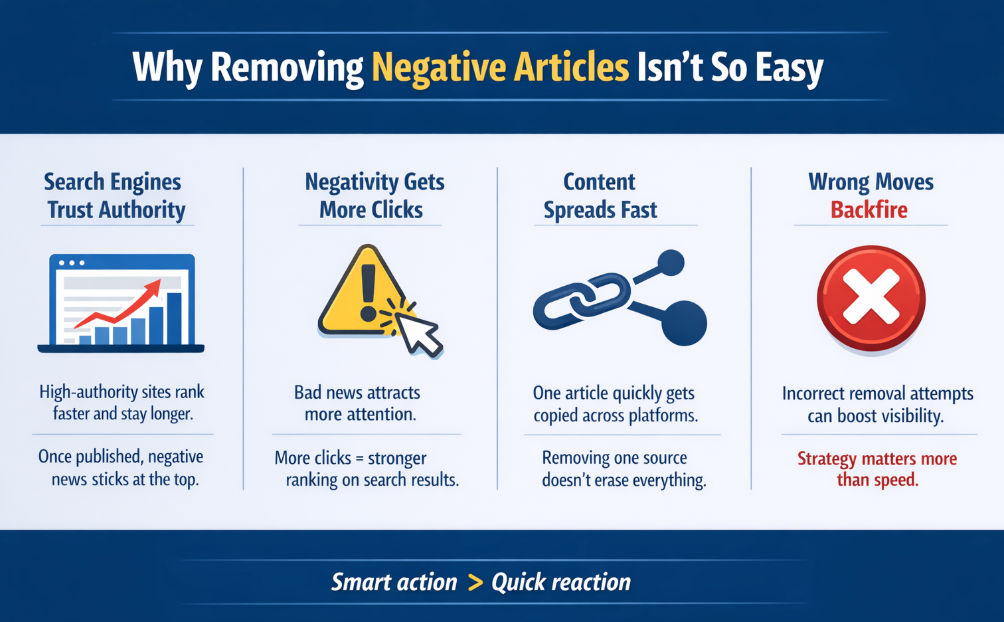
1. The way Google works is not in your favor
News websites and established publications carry high domain authority, which means Google trusts them and ranks their content quickly. A negative article on one of these sites can shoot to the top of search results within days and stay there for years.
2. Negative content naturally attracts more attention
People click on negative stories more than positive ones. The more clicks an article gets, the more Google treats it as relevant and important, which keeps it ranked high and makes it even harder to push down or remove bad articles from Google.
3. One article rarely stays in one place
Once something is published, other websites pick it up, reference it, and republish it. By the time most people take action, the content has already spread across multiple platforms, and removing just the original source does not solve the problem.
4. Failed attempts can make things worse
Every incorrect removal request, every wrong move on the wrong platform, signals activity around that content. This can reinforce its presence online rather than weaken it, which is why the approach matters just as much as the action itself.
What Are the Real Routes to Getting an Article Taken Down?
There is no one method to remove negative articles from Google that works for every case. What works depends on the type of content, where it is published, and whether it breaks any rules. Here is an honest look at what your options are in 2026 and who is best placed to handle each one.
| Removal Route | When It Works | Who Should Handle It |
| Contact the publisher directly | The article has wrong information, is outdated, or the website has a corrections policy | A professional who knows how to write the right request and reach the right person |
| Google deindexing | The article contains personal details like your home address, phone number, or financial information | Possible to attempt yourself, but requires very specific documentation to get approved |
| DMCA takedown | Someone used your photos, written content, or videos without your permission | Someone with experience filing these correctly, wrong filings get rejected |
| Legal action | The content is completely false, damaging, and you can prove it | Needs a legal professional, this route should never be handled alone |
| Suppression | The article cannot be removed, but it needs to stop showing up on page one | Requires proper content removal services with SEO knowledge and access to strong platforms |
What Happens When People Try to Fix This Without Professional Help?
This is the part that does not get talked about enough. Most people who discover a negative article about themselves online try to handle it on their own first. That is completely understandable. What is not talked about enough is how often those attempts make the situation harder to fix, not easier. Investing in Google suppression services early saves a lot more than just time.
- Choosing the wrong removal route wastes weeks: Filing the wrong type of request on the wrong platform does not just fail, it can delay the entire process and give the article more time to gain authority online.
- Repeated failed attempts can work against you: Every time a removal request gets rejected, it creates a paper trail that can make future attempts harder, and some platforms deprioritize cases that have already been flagged multiple times unsuccessfully.
- Removing the original does not remove everything: Most people focus on the source article and do not realize it has already been picked up and republished across five or six other websites. The problem continues even after the original comes down.
- No monitoring after removal means it comes back: Content that gets removed without any follow-up monitoring can resurface within weeks, and without a system in place to catch it, most people do not find out until it is ranking again.
- Every day without action costs you: While someone is figuring out the right steps to remove negative search results, that article is still sitting on page one, still being seen, and still doing damage to real opportunities.
| By the time most people call us, the article has already been up for months. Every day it stayed there, it got harder to move. We have seen what delayed action costs people, and we have also seen what the right approach can do in a matter of weeks. There is always a way forward. You just need someone who knows where to start. |
| — Founder & CEO, MGMT Reputation |
How MGMT Reputation Makes it Easier to Remove Negative Search Results
When a negative article is sitting on page one, and everything you have tried has not worked, the problem is rarely the content itself. It is the approach. MGMT Reputation specializes in exactly this by removing harmful content across Google, Google, Reddit, TikTok, AWDTSG, Glassdoor, and major news publications, with a process that is fast, confidential, and built around what actually gets results. For businesses and individuals who are done guessing, this is what structured online reputation repair services look like in practice.
Step 1: Full audit first, action second
MGMT Reputation starts by mapping out every piece of harmful content, where it lives, how far it has spread, and which solution gives it the best realistic chance of coming down.
Step 2: The right removal route for the right content
A direct publisher request works differently from a DMCA filing, which works differently from a legal pathway. MGMT Reputation identifies which route fits the content and executes it correctly the first time, because failed attempts make future ones harder.
Step 3: Suppression for anything that cannot come down
Not everything can be fully deleted, but it can be pushed far enough down that it stops affecting you. Using targeted SEO and high-authority content, MGMT Reputation works to remove bad articles from Google search results by replacing them with stronger, more credible content that takes their place on page one.
Step 4: Monitoring so the problem does not come back
Once content is removed or suppressed, MGMT Reputation keeps tracking your search results so that if anything resurfaces, it gets handled before it has the chance to rank again.
The Article Will Not Disappear on Its Own
Negative articles do not go away with time, they spread. Other websites pick them up, Google keeps them ranked, and AI tools keep pulling from them. Every day that article stays up, it is reaching people who were about to look for you and making a decision before you even get a chance. How you handle it and how soon you act make all the difference in what can still be done.
MGMT Reputation has helped businesses and individuals clean up what shows up when someone searches their name. The work is done fast, handled privately, and built around getting real results. If something online is hurting your business or your name and you are not sure where to start, reach out to MGMT Reputation today and find out what it will take to remove negative content from the internet for good.
FAQs
Q1. Can I remove a negative article from Google myself?
You can try, but without knowing the right process and platform rules, most attempts fail or make the situation harder to fix.
Q2. How long does it take to remove a negative article from the internet?
It depends on the content and platform. Some removals happen within days, while others involving legal routes can take several weeks.
Q3. What if the article is true, can it still be removed?
Sometimes yes. Outdated, irrelevant, or privacy-violating content can still qualify for removal or suppression even if it is factually accurate.
Q4. Will the article come back after it has been removed?
It can, which is why monitoring after removal matters. Without ongoing tracking, content can resurface on other sites without you knowing.
Q5. Is it possible to remove a negative article from Google without deleting it from the original website?
Yes. Google deindexing removes an article from search results while it still exists on the website, making it effectively invisible to most people.